The Uncomfortable Math
Enterprises spent $184 billion on AI in 2025 according to IDC. RAND Corporation's research puts the failure rate of AI projects at roughly 80%. MIT Sloan found that 95% of generative AI pilots never scale past proof-of-concept.
The instinct is to blame the technology. Models hallucinate. Data is dirty. Use cases were wrong.
But GPT-4, Claude, and Gemini are increasingly capable, accessible, and cheap. If technology were the bottleneck, the failure rate would be shrinking. It isn't.
The problem is structural. Enterprises are inserting AI into organisations never designed for it -- architectures built for manual decisions, processes shaped by human cognitive limits, operating models that assume people think and systems store. That approach produces expensive pilots that demo well and deliver nothing at scale.
Diagnosis: Three Layers, Zero Integration
I keep seeing the same pattern. A company makes a significant AI investment. A few pilots succeed. The governance deck looks polished in the board room. Then: a wall.
The wall exists because AI transformation gets treated as technology adoption. Leaders ask "Where can we deploy AI?" Wrong question. The right one: "How must our organisation change to operate with AI as a core design element?"
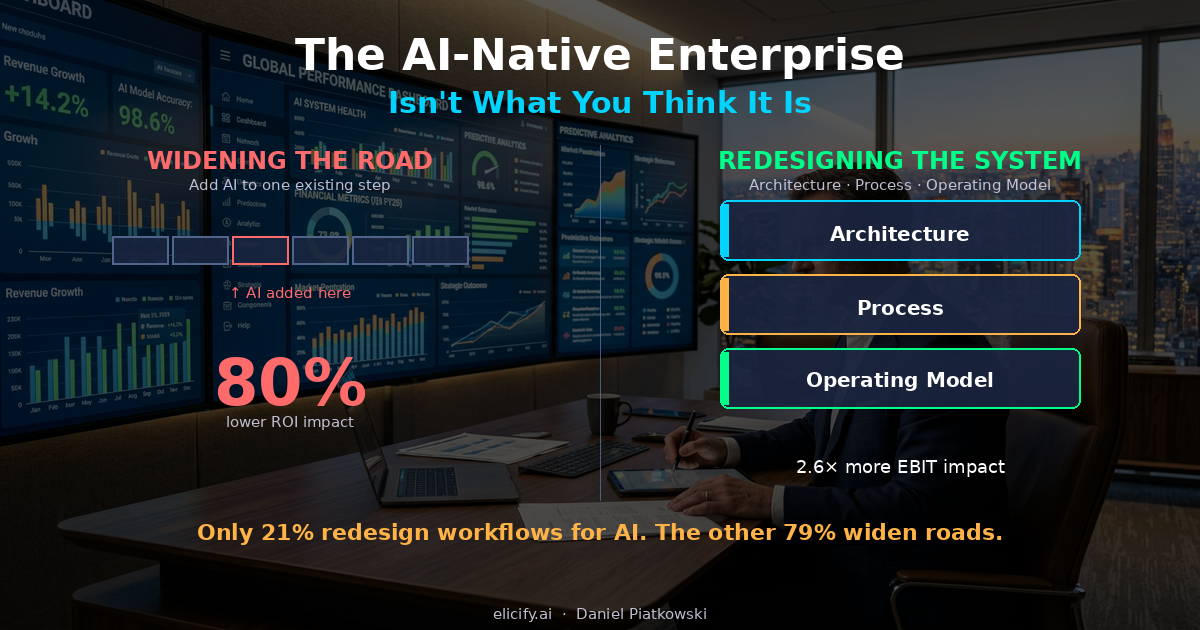
McKinsey's 2025 State of AI report makes this concrete. Fundamental workflow redesign is the strongest predictor of real EBIT impact from AI. Yet only 21% of organisations using generative AI have redesigned any workflows. The other 79% run AI on top of processes designed for a world without it.
Klarna's experience illustrates this perfectly. They replaced 700 customer service agents with AI, celebrated the efficiency gains publicly, then quietly started rehiring humans when customer satisfaction dropped. CEO Sebastian Siemiatkowski admitted they "focused too much on efficiency." The AI was brilliant at handling volume. But the surrounding workflow -- escalation paths, quality feedback loops, the human judgment layer -- was not redesigned for that throughput. New bottlenecks. Frustrated customers. A public reversal.
Three layers must change together. Architecture: how data flows and how AI participates in decisions. Process: how work actually gets done -- redesigned, not automated. Operating model: how people collaborate with AI, what roles exist, what governance enables responsible autonomy. Change one without the others and you get expensive disappointment.
%%{init: {'theme': 'base', 'themeVariables': {'primaryColor': '#1a2540', 'primaryTextColor': '#ffffff', 'primaryBorderColor': '#ffffff', 'lineColor': '#ffffff', 'background': '#0a0f1e', 'mainBkg': '#1a2540', 'nodeBorder': '#ffffff', 'clusterBkg': '#0a0f1e', 'titleColor': '#ffffff', 'edgeLabelBackground': '#1a2540'}}}%%
graph TD
    A["ARCHITECTURE\nData flows, Integration, Explainability"] -->|"constrains"| B["PROCESS\nWorkflow redesign, Human-AI handoffs"]
    B -->|"shapes"| C["OPERATING MODEL\nRoles, Governance, Capability"]
    C -->|"feeds back into"| A
    A -.->|"Without process redesign:\ndata walls"| X["FAILURE"]
    B -.->|"Without operating model:\nchaos"| X
    C -.->|"Without architecture:\nno productivity gain"| X
    style A fill:#1a2540,color:#00d4ff,stroke:#ffffff,stroke-width:2px
    style B fill:#1a2540,color:#ffb347,stroke:#ffffff,stroke-width:2px
    style C fill:#1a2540,color:#00ff88,stroke:#ffffff,stroke-width:2px
    style X fill:#ff4444,color:#ffffff,stroke:#ffffff,stroke-width:2px
Reframe: AI Transformation Is Urban Planning
The technology industry frames AI transformation as a technology problem because technology problems have technology solutions with price tags. Convenient for vendors. Catastrophic for enterprises.
Here is a better lens: urban planning.
When a city has a traffic problem, the naive response is to widen the road. It works briefly. Then induced demand fills the new capacity and congestion returns -- often worse, because the wider road encouraged more driving. Transportation planners call this Braess's paradox: adding capacity to a network can reduce its overall performance.
Enterprises deploying AI are widening roads. They add AI capacity to one process step, which shifts the bottleneck downstream, which creates pressure on the operating model, which surfaces data quality issues nobody noticed before. The system fights back.
Effective cities don't fix traffic by widening roads. They redesign the transport system -- zoning, public transit, cycling infrastructure, mixed-use development -- so that the demand patterns change. The same logic applies to AI-native enterprises. You don't optimise individual steps. You redesign the system so AI changes the demand patterns themselves.
McKinsey's data backs this up. AI high performers -- the roughly 6% reporting 5%+ EBIT impact -- are 2.8 times more likely to have done fundamental workflow redesign. They are redesigning how their organisations work, not just deploying better models.
I'm not sure this urban planning analogy holds perfectly at every scale. But the core insight is sound: optimising components independently often degrades the system. And that is exactly what 80% of AI investments are doing.
%%{init: {'theme': 'base', 'themeVariables': {'primaryColor': '#0a0f1e', 'primaryTextColor': '#ffffff', 'primaryBorderColor': '#ffffff', 'lineColor': '#ffffff', 'background': '#0a0f1e', 'mainBkg': '#0a0f1e', 'nodeBorder': '#ffffff', 'clusterBkg': '#1a2540', 'titleColor': '#ffffff', 'edgeLabelBackground': '#1a2540', 'tertiaryColor': '#1a2540'}}}%%
pie title Where AI Transformation Budget Goes vs Where It Should
    "Technology and Tools (90%+ of budget)" : 90
    "Process Redesign (21% of orgs attempt)" : 6
    "Operating Model Change (rarely addressed)" : 4
The Integrated Design Framework
An AI-native enterprise is designed around three interlocking layers.
Layer 1: Architecture -- Design for AI Participation
Traditional architecture centres on human decision-making. Data flows to dashboards. Humans analyse. Humans decide. Systems execute.
AI-native architecture inverts this. AI participates in decision loops at speed and scale humans cannot match. This demands:
- Event-driven data flows. AI needs real-time data, not yesterday's batch reports. A claims processing agent waiting on overnight batch updates is an expensive way to recreate the delays you were trying to eliminate.
- Unified governance. AI agents cannot work with inconsistent data. When your customer table in the CRM defines "active" differently from your billing system, a human might muddle through. An AI agent will confidently make wrong decisions at scale. Databricks Unity Catalog and Snowflake governance exist for exactly this reason.
- Explainability by design. When AI participates in consequential decisions -- credit approvals, insurance claims, hiring recommendations -- reasoning must be traceable and auditable. This is an architectural choice, not a compliance afterthought.
- Integration patterns that treat AI as a first-class participant. Not an API bolted onto the side. AI agents need to read from and write to the same systems humans use, with the same data quality standards.
Layer 2: Process -- Redesign, Don't Automate
This is where most go wrong. Automating a broken process scales the dysfunction.
Capgemini's ESOAR methodology captures the right sequence: Eliminate unnecessary steps. Standardise what remains. Optimise the flow. Then Automate and Robotise. Most enterprises skip straight to automation. That's why the results disappoint.
%%{init: {'theme': 'base', 'themeVariables': {'primaryColor': '#1a2540', 'primaryTextColor': '#ffffff', 'primaryBorderColor': '#ffffff', 'lineColor': '#ffffff', 'background': '#0a0f1e', 'mainBkg': '#1a2540', 'nodeBorder': '#ffffff'}}}%%
flowchart LR
    E["ELIMINATE\nRemove unnecessary\nsteps entirely"] --> S["STANDARDISE\nUnify remaining\nprocess variations"]
    S --> O["OPTIMISE\nStreamline flow\nand handoffs"]
    O --> A["AUTOMATE\nApply AI to\noptimised process"]
    A --> R["ROBOTISE\nScale with\nfull automation"]

    SKIP["Most enterprises\nstart here"] -.-> A

    style E fill:#0a2a1e,color:#00ff88,stroke:#ffffff,stroke-width:2px
    style S fill:#1a2540,color:#00d4ff,stroke:#ffffff,stroke-width:2px
    style O fill:#1a2540,color:#00d4ff,stroke:#ffffff,stroke-width:2px
    style A fill:#1a2540,color:#ffb347,stroke:#ffffff,stroke-width:2px
    style R fill:#1a2540,color:#ffb347,stroke:#ffffff,stroke-width:2px
    style SKIP fill:#ff4444,color:#ffffff,stroke:#ffffff,stroke-width:2px
Three principles for process redesign:
- Start with outcomes, not tasks. Design backward from what the process achieves, not forward from the existing task list.
- Design for human judgment, not human execution. AI handles execution at scale. Humans handle ambiguous, high-stakes calls.
- Build learning loops in. AI-native processes improve with every execution because they generate feedback data. This does not happen by accident.
Layer 3: Operating Model -- The Hardest Part
McKinsey's research on the agentic organisation describes the shape: flat decision structures, high context sharing, real-time governance, empowered teams that include both humans and AI agents.
This layer requires rethinking:
- Roles and decision rights. When AI drafts the analysis, what does the analyst do? When AI handles routine decisions, who handles the exceptions? These boundaries must be explicit, not discovered in a crisis.
- Governance speed. Quarterly reviews and annual planning cycles are too slow. Governance must become continuous and embedded in the workflow.
- Trust architecture. People work with AI effectively when they understand it, can interrogate its outputs, and have clear escalation paths when it is wrong.
This is also the layer where I've seen the most resistance. The hardest part isn't the technology or even the process -- it's convincing a senior credit officer that an AI agent's risk assessment deserves equal consideration to their 20 years of experience. That conversation has no technical solution.
Application: JP Morgan's COIN and ING's GenAI Transformation
Two real examples show what integrated design across all three layers looks like.
JP Morgan's COIN system tackled commercial lending -- exactly the kind of operation that demands all three layers. The AI reviews 12,000 commercial credit agreements per year, a task that previously consumed 360,000 hours of legal work annually. The architecture delivers real-time document feeds to AI models with unified governance. The process was redesigned: instead of lawyers reading every clause sequentially, AI handles extraction and risk flagging, humans handle exceptions and final judgment. The operating model shifted lawyers from document review to AI supervision -- knowing when to trust the extraction and when to override. The result: near-zero error rate, massive time savings, and lawyers doing higher-value work.
ING Bank took a different path to the same destination. Working with McKinsey, they built a GenAI chatbot in seven weeks that delivered a 25% productivity gain in operations, with projected impact across their 37 million customers. The key was not the chatbot itself -- it was redesigning how human agents and AI collaborate, with clear escalation paths and governance baked into the workflow from day one.
The tradeoff nobody talks about: both transformations required months of process redesign and role renegotiation before the AI delivered value. The technology was the easy part. Redesigning the operating model -- convincing experienced professionals that AI supervision is more valuable than manual execution -- was the real project.
The Implication
Technology is commoditising. Foundation models are available to anyone with an API key. The competitive advantage belongs to organisations that design across all three layers -- architecture, process, operating model -- simultaneously. The 80% failure rate is a design problem. It will persist until enterprises stop inserting AI into existing structures and start designing fundamentally different ones.
Sources
- IDC Worldwide AI Spending Forecast 2025
- RAND Corporation: Why AI Projects Fail
- MIT Sloan: Why Most AI Initiatives Still Fail
- McKinsey: The State of AI in 2025
- Capgemini: ESOAR Intelligent Automation
- Braess's Paradox (Wikipedia)
- Fortune: Klarna reverses AI-first customer service strategy
- McKinsey: Banking on Innovation -- How ING Uses Generative AI
- JP Morgan: Artificial Intelligence
Daniel Piatkowski Data & Analytics veteran shaping AI-native enterprises elicify.ai