Most enterprises aren't failing at AI because of bad models. They're failing because they're deploying good models into architectures that were never designed to act on them.
Adding a copilot to a decade-old workflow isn't transformation. It's renovation. The approval chains still route to human inboxes. The data still refreshes nightly. The agent still waits three days for a sign-off that exists because someone made a bad call in 2019. You've given a Formula 1 engine to a horse-drawn carriage. The engine works. The carriage is the problem.
Renovation vs. Rebuild
The AI-native enterprise isn't an AI-enhanced enterprise. It's a fundamentally different kind of organisation — designed from first principles across three layers: architecture, process, and operating model. Gartner's research on AI-native architecture argues that by 2027, organisations treating AI as an architectural paradigm rather than a technology addition will outperform peers by more than 30% on productivity metrics.
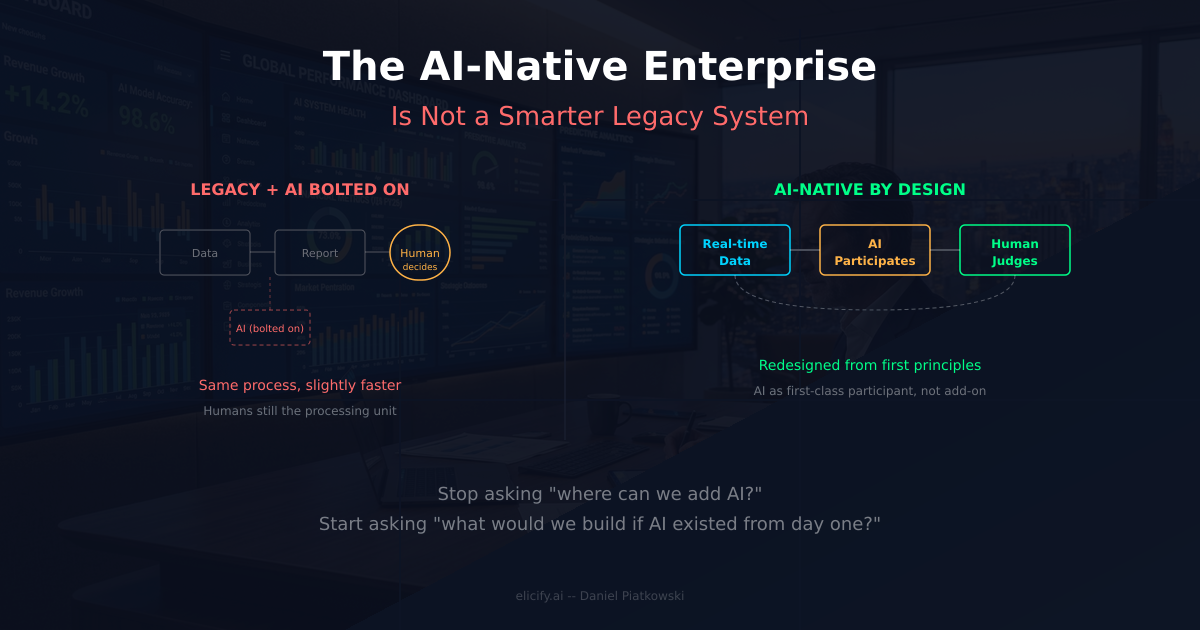
Most organisations are stuck in renovation mode. They bolt AI onto existing systems: a chatbot on the helpdesk, a recommendation engine on the e-commerce site, a summarisation tool in the document workflow. Each addition makes the system marginally better at what it already did. None of them change what the system does.
The constraints that shaped legacy architecture no longer exist. Data doesn't need to move in nightly batches because humans are asleep. Decisions don't need to queue for approval because a human must review them. Reports don't need to be pre-built because someone decided which metrics mattered in 2018. These constraints were human-shaped. AI removes them. But only if the architecture is designed to let AI act, not just advise.
%%{init: {'theme': 'base', 'themeVariables': {'primaryColor': '#1a2540', 'primaryTextColor': '#ffffff', 'primaryBorderColor': '#ffffff', 'lineColor': '#ffffff', 'background': '#0a0f1e', 'mainBkg': '#1a2540', 'nodeBorder': '#ffffff', 'edgeLabelBackground': '#1a2540'}}}%%
graph LR
    subgraph LEGACY ["Renovation: AI-Enhanced Legacy"]
        L1["Nightly batch data"] --> L2["Human approval gates"] --> L3["Pre-built reports"] --> L4["Copilot added"]
    end
    subgraph NATIVE ["Rebuild: AI-Native"]
        N1["Real-time events"] --> N2["AI decides in-loop"] --> N3["APIs for agents"] --> N4["Humans govern exceptions"]
    end
    style LEGACY fill:#2a1a1a,stroke:#ff6b6b,color:#ffffff
    style NATIVE fill:#0a2a1e,stroke:#00ff88,color:#ffffff
    style L1 fill:#1a2540,stroke:#ff6b6b,color:#ffffff
    style L2 fill:#1a2540,stroke:#ff6b6b,color:#ffffff
    style L3 fill:#1a2540,stroke:#ff6b6b,color:#ffffff
    style L4 fill:#1a2540,stroke:#ff6b6b,color:#ffffff
    style N1 fill:#1a2540,stroke:#00ff88,color:#ffffff
    style N2 fill:#1a2540,stroke:#00ff88,color:#ffffff
    style N3 fill:#1a2540,stroke:#00ff88,color:#ffffff
    style N4 fill:#1a2540,stroke:#00ff88,color:#ffffff
Three Layers of AI-Native Design
Architecture built for AI consumption. Legacy data architectures were designed for human consumption: reports, dashboards, summaries. A human reads them and decides. AI-native architectures are designed for machine consumption: APIs, events, embeddings, real-time streams. The data layer doesn't answer questions. It enables action. This isn't a technology upgrade. It's a paradigm shift from "data for insight" to "data for operation."
Processes redesigned from first principles. Most enterprise processes were designed under constraints that no longer apply. A loan application involves seven handoffs because seven humans needed to touch it. An inventory reorder requires three approvals because three people needed to agree. These structural features aren't logic. They're scar tissue from old constraints. AI-native process design asks: "If AI could do any part of this, what would the process look like?" The answer is rarely "the same process, slightly faster."
Operating model redesigned for human-AI collaboration. The AI-native enterprise doesn't have fewer humans. It has humans doing different work. When AI handles routine decisions, humans handle exceptions. When AI generates first drafts, humans edit for nuance. When AI monitors at scale, humans investigate anomalies. The operating model must define who does what, who owns what, and who is accountable when the AI and human disagree. Most organisations have not started this work.
%%{init: {'theme': 'base', 'themeVariables': {'primaryColor': '#1a2540', 'primaryTextColor': '#ffffff', 'primaryBorderColor': '#ffffff', 'lineColor': '#ffffff', 'background': '#0a0f1e', 'mainBkg': '#1a2540', 'nodeBorder': '#ffffff', 'edgeLabelBackground': '#1a2540'}}}%%
graph TB
    Core["AI-Native Enterprise"]
    Core --> Arch["Architecture
Real-time, API-first"]
    Core --> Proc["Processes
Redesigned from outcomes"]
    Core --> Op["Operating Model
Human-AI collaboration"]
    Arch --> AD1["Events, not batches"]
    Arch --> AD2["APIs, not reports"]
    Proc --> PD1["Exception-based review"]
    Proc --> PD2["AI at decision centre"]
    Op --> OD1["Clear AI ownership"]
    Op --> OD2["Humans govern, not execute"]
    style Core fill:#1a2540,stroke:#00d4ff,color:#ffffff
    style Arch fill:#1a2540,stroke:#00d4ff,color:#ffffff
    style Proc fill:#1a2540,stroke:#ffb347,color:#ffffff
    style Op fill:#1a2540,stroke:#00ff88,color:#ffffff
The Carriage Problem
A Nordic retailer I advised last year had invested heavily in AI demand forecasting. The models were excellent — 40% better prediction accuracy than their previous statistical approach. But the supply chain process couldn't act on the predictions. The purchase orders still went out weekly. The approval gates still required human sign-off. The warehouse system still expected forecasts in the format it had used since 2015.
The AI was a Formula 1 engine. The process was a horse-drawn carriage. The engine didn't make the carriage faster. It made the mismatch more obvious.
The fix wasn't better models. It was redesigning the supply chain process around what AI made possible: real-time reorders, automated low-risk purchases, exception-based human review. The architecture had to change. The process had to change. The roles had to change. Only then did the AI investment pay off. Eighteen months after the redesign, inventory carrying costs had dropped 22% and stockouts had fallen by more than half — improvements the model accuracy alone couldn't produce.
The Urban Planning Analogy
Think about what happened to cities when cars arrived. Early twentieth-century planners didn't say "horses were slow, cars are faster, problem solved." They rebuilt the city. Wider streets. Traffic signals. Parking structures. Zoning that separated residential from commercial because the car made commuting possible. The horse-era city wasn't adapted. It was replaced, block by block, over fifty years.
Every city that tried to keep the horse-era street grid and just let cars drive on it ended up gridlocked. The technology didn't fail. The infrastructure couldn't absorb what the technology made possible.
AI is in its horse-to-car moment. The enterprises that try to keep the old grid and just let AI drive on it will hit the same gridlock — slower decisions than before, because the AI is waiting on approval chains that weren't designed for its speed. The ones that rebuild the infrastructure will find that the technology starts delivering what the vendor demos promised.
The Question That Changes Everything
Stop asking "where can we add AI?" Start asking "what would we build if AI existed from day one?"
The first question produces renovation: smarter reports, faster approvals, better recommendations. The second question produces transformation: processes that couldn't exist without AI, architectures designed for machine action, operating models that treat human and AI capabilities as complementary by design.
Most enterprises are asking the first question. The ones that will dominate the next decade are asking the second.
The uncomfortable part is that rebuilding is slower than renovating — in the short term. Year one of an AI-native redesign looks worse on the balance sheet than year one of adding copilots. But by year three, the rebuild compounds and the renovation plateaus. The question leadership needs to answer isn't "which is faster?" It's "which are we prepared to see through long enough to matter?"
Sources
- McKinsey: The State of AI in 2024
- Gartner: AI-Native Architecture Trends
- Databricks: Building AI-Native Applications
Daniel Piatkowski Data & Analytics veteran shaping AI-native enterprises elicify.ai