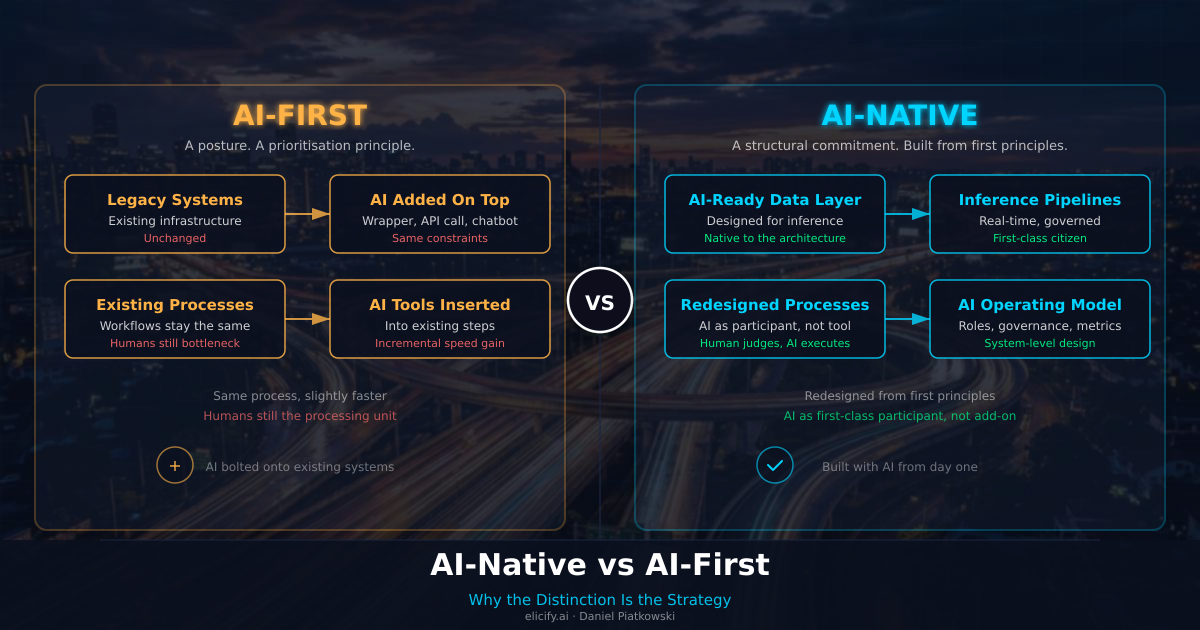
Every enterprise strategy deck in 2026 contains one of two phrases: "AI-first" or "AI-native." They're used interchangeably in boardrooms, investor updates, and transformation roadmaps. Most executives who use them couldn't tell you the difference.
That confusion is not semantic. It is structural. And it is costing organisations years of misaligned investment.
The Problem With "AI-First"
"AI-first" entered the enterprise lexicon around 2017, when Google CEO Sundar Pichai declared the company was shifting from "mobile-first" to "AI-first." The phrase caught on. By 2023, every major consulting firm had an AI-first framework. By 2025, it had become the default language of digital strategy.
But here is what "AI-first" actually means in practice: we will prioritise AI when making decisions about our existing business.
It is a posture. A prioritisation principle. It says: when faced with a choice, choose the AI-enabled path. It does not say anything about the architecture of the systems you are building, the structure of the organisation operating them, or the design of the processes running through them.
AI-first is a strategy adjective. AI-native is a structural noun. The distinction matters because one tells you what to prioritise. The other tells you what to build.
What "AI-Native" Actually Means
AI-native means the system — the product, the process, the organisation — was conceived with AI as a foundational component, not added to it later.
The clearest way to understand this is through an analogy. Consider the difference between a building retrofitted for electricity versus one designed with electrical systems from the ground up. Both have electricity. But the retrofitted building has wiring running along the outside of walls, fuse boxes in inconvenient locations, and circuits that were never designed to carry modern loads. The native building has electrical systems integrated into its structure — invisible, efficient, and capable of handling whatever the building needs.
Most enterprise AI deployments today are retrofits. AI is being layered onto processes designed for human execution, data architectures built for reporting rather than inference, and organisational structures that were never designed to incorporate machine judgment.
AI-native means starting from a different question: If AI were a core component from day one, what would this look like? The answer to that question produces fundamentally different architecture, fundamentally different processes, and fundamentally different operating models.
Three Dimensions Where the Gap Shows Up
1. Architecture
An AI-first architecture takes an existing system and adds AI capabilities to it. The data warehouse gets a machine learning layer. The CRM gets a recommendation engine. The customer service platform gets a chatbot. Each AI component is additive — bolted on, integrated via API, dependent on data pipelines that were designed for other purposes.
An AI-native architecture is designed around the assumption that AI models will be first-class consumers of data. Data models are designed for feature engineering, not just reporting. Pipelines are built for real-time inference. APIs serve model inputs and outputs. Feedback loops are built in from the start — every interaction generates training signal.
The practical consequence: AI-first architectures hit a ceiling. You can add AI to a legacy data model, but you cannot make that data model AI-native without rebuilding it. Organisations that start AI-first eventually face a rearchitecting moment — often after significant investment in the wrong direction.
graph TD
    subgraph AI_FIRST["AI-First Architecture (Retrofit)"]
        A1[Legacy Data Warehouse] -->|ETL| B1[Reporting Layer]
        A1 -->|Added Later| C1[ML Layer]
        C1 -->|Bolted On| D1[AI Features]
        B1 --> E1[Dashboards]
        D1 --> F1[Recommendations]
        style C1 fill:#f59e0b,color:#000
        style D1 fill:#f59e0b,color:#000
    end

    subgraph AI_NATIVE["AI-Native Architecture (Designed)"]
        A2[Unified Data Platform] -->|Real-time| B2[Feature Store]
        A2 -->|Streaming| C2[Inference Pipeline]
        B2 --> D2[Model Serving]
        C2 --> D2
        D2 -->|Feedback Loop| A2
        D2 --> E2[AI-Powered Experiences]
        style A2 fill:#0891b2,color:#fff
        style B2 fill:#0891b2,color:#fff
        style C2 fill:#0891b2,color:#fff
        style D2 fill:#0891b2,color:#fff
    end
2. Process Design
AI-first process design takes an existing workflow and asks: where can we insert AI to make this faster or cheaper? The process remains human-centric. AI is a tool that assists humans at specific steps.
AI-native process design asks a different question: If AI were executing this process, what would the process look like? This often produces a completely different process — not an optimised version of the old one, but a fundamentally redesigned one.
Consider a loan underwriting process. An AI-first approach adds an AI model to the existing underwriting workflow — it scores applications, flags anomalies, and recommends decisions, but a human underwriter still reviews and approves each case. The process structure is unchanged. An AI-native approach redesigns the process from first principles: What decisions actually require human judgment? What can be fully automated? What does the human role become when AI handles 80% of cases autonomously? The result is a different process, not a faster version of the old one.
flowchart LR
    subgraph AIFIRST["AI-First Process"]
        direction TB
        P1[Receive Application] --> P2[Human Review]
        P2 --> P3[AI Score Added]
        P3 --> P4[Human Decision]
        P4 --> P5[Outcome]
        style P3 fill:#f59e0b,color:#000
    end

    subgraph AINATIVE["AI-Native Process"]
        direction TB
        Q1[Receive Application] --> Q2{AI Triage}
        Q2 -->|Routine 80%| Q3[Automated Decision]
        Q2 -->|Complex 15%| Q4[Human + AI Review]
        Q2 -->|Edge Case 5%| Q5[Senior Human Review]
        Q3 --> Q6[Outcome + Feedback Loop]
        Q4 --> Q6
        Q5 --> Q6
        Q6 -->|Retrains Model| Q2
        style Q2 fill:#0891b2,color:#fff
        style Q3 fill:#0891b2,color:#fff
        style Q6 fill:#0891b2,color:#fff
    end
3. Operating Model
This is where the distinction has the most profound and least-discussed implications.
An AI-first operating model adds AI capabilities to an existing organisational structure. You hire data scientists, create a Centre of Excellence, and embed AI tools into existing teams. The org chart looks roughly the same. Decision rights are roughly the same. Governance is roughly the same. AI is a capability layer on top of an unchanged operating model.
An AI-native operating model is designed around the assumption that AI systems will be making a significant proportion of decisions — and that humans will be governing, overseeing, and improving those systems rather than executing the decisions themselves.
This changes everything: role design shifts from people who do tasks to people who govern systems that do tasks. Decision rights shift from human approval chains to AI execution with human oversight thresholds. Governance shifts from process compliance to model performance monitoring. Skills shift from domain execution to AI system management and model evaluation. Accountability shifts from individual task ownership to system outcome ownership.
Most organisations have not made this transition. They have added AI tools to an operating model designed for human execution, and they are wondering why the productivity gains are not showing up at the organisational level.
Why This Matters Now
The gap between AI-first and AI-native is not academic. It is showing up in competitive performance.
Organisations that are genuinely AI-native — those that have redesigned their architecture, processes, and operating models around AI — are not just faster or cheaper at existing tasks. They are doing things that AI-first organisations structurally cannot do: real-time personalisation at scale, continuous process improvement through built-in feedback loops, autonomous execution of routine decisions, and rapid model iteration.
The AI-first organisation is running a faster horse. The AI-native organisation has built a car.
This is not a criticism of AI-first as a starting point. For most large enterprises, starting AI-first is pragmatic — you cannot redesign everything at once. But AI-first must be understood as a transitional posture, not a destination. The organisations that treat it as a destination will find themselves perpetually retrofitting, perpetually catching up, and perpetually explaining why their AI investments are not delivering transformation.
The Transition: From AI-First to AI-Native
The path from AI-first to AI-native is not a single transformation programme. It is a sustained architectural shift across three layers, executed in sequence.
Layer 1 — Data Architecture (12–18 months): Redesign the data layer for AI consumption. Move from batch-oriented data warehouses to real-time, feature-store-enabled platforms. Databricks, Snowflake, and similar platforms provide the foundation — but the design decisions matter as much as the technology choices. The goal is a data architecture where AI models are first-class consumers, not afterthoughts.
Layer 2 — Process Redesign (18–24 months): Identify the 20% of processes that account for 80% of your operational cost and decision volume. Redesign these from first principles for AI execution. Do not optimise existing processes — question whether they should exist in their current form at all. The output is a smaller set of redesigned processes with AI at the centre and humans in governance and exception-handling roles.
Layer 3 — Operating Model (24–36 months): Redesign roles, decision rights, governance, and accountability structures for an AI-native operating model. This is the hardest layer — it requires changes to how people work, how they are measured, and what they are accountable for. It cannot be done without the first two layers in place.
graph TD
    START([AI-First Posture]) --> L1

    subgraph L1["Layer 1: Data Architecture (12-18 months)"]
        D1[Audit current data models] --> D2[Identify AI consumption gaps]
        D2 --> D3[Build feature store and real-time pipelines]
        D3 --> D4[Validate with first AI-native use cases]
    end

    L1 --> L2

    subgraph L2["Layer 2: Process Redesign (18-24 months)"]
        P1[Map high-volume decision processes] --> P2[Redesign for AI execution]
        P2 --> P3[Define human oversight thresholds]
        P3 --> P4[Build feedback loops into every process]
    end

    L2 --> L3

    subgraph L3["Layer 3: Operating Model (24-36 months)"]
        O1[Redesign roles around AI governance] --> O2[Shift decision rights to AI systems]
        O2 --> O3[Build model performance governance]
        O3 --> O4[Measure outcomes not activities]
    end

    L3 --> END([AI-Native Enterprise])

    style START fill:#64748b,color:#fff
    style END fill:#0891b2,color:#fff
The Strategic Implication
The most important question a senior leader can ask right now is not "Are we AI-first?" Most organisations can truthfully answer yes to that. The question is: "Are we on a credible path to AI-native?"
That question has a concrete answer. Either you have a data architecture that supports AI-native operations, or you do not. Either you have processes redesigned for AI execution, or you do not. Either you have an operating model that assigns decision rights to AI systems with appropriate human oversight, or you do not.
The distinction between AI-first and AI-native is not a maturity model where every organisation eventually arrives at the top. It is a strategic choice about what kind of organisation you are building. And the organisations that make that choice explicitly — and architect accordingly — are the ones that will define their industries in the next decade.
AI-first tells you what to prioritise. AI-native tells you what to build. Only one of those is a strategy.