The Headline Everyone Missed
Meta is firing 8,000 people on May 20. Microsoft is buying out 8,750 more. Snap cut 1,000. Atlassian shed 1,600. The reason given in every memo? "Rapid advancements in artificial intelligence."
Here's what nobody is saying out loud: the AI isn't doing the work yet.
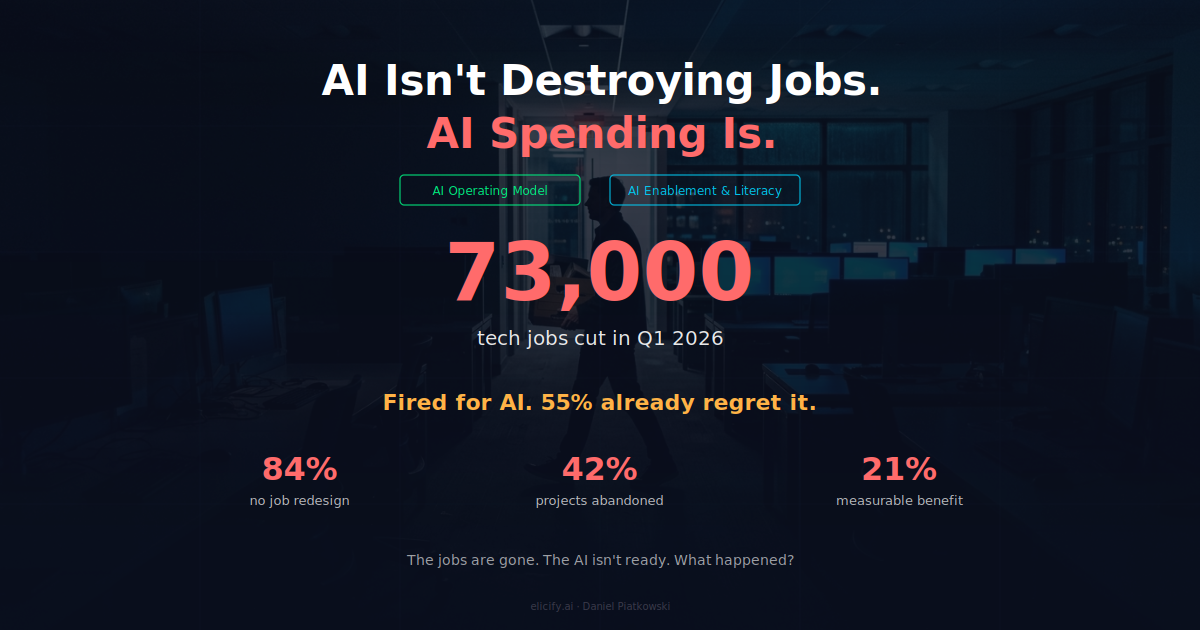
Goldman Sachs estimates AI is displacing 16,000 U.S. jobs per month. 73,000 tech jobs were eliminated in Q1 2026 alone. But Deloitte's 2026 State of AI report found that 84% of companies haven't redesigned a single job around AI capabilities. S&P Global reports 42% abandoned most of their AI projects in 2025. Morgan Stanley found only 21% of S&P 500 companies can cite a measurable AI benefit at all.
The jobs are gone. The AI isn't ready. What actually happened is simpler and more brutal: companies traded payroll for infrastructure and called it progress.
%%{init: {'theme': 'base', 'themeVariables': {'primaryColor': '#1a2540', 'primaryTextColor': '#ffffff', 'primaryBorderColor': '#ffffff', 'lineColor': '#ffffff', 'background': '#0a0f1e', 'mainBkg': '#1a2540', 'nodeBorder': '#ffffff', 'edgeLabelBackground': '#1a2540'}}}%%
flowchart LR
    subgraph In["What Went In"]
        J["73,000 Jobs<br/>Q1 2026"]
        D["$675B AI Infrastructure<br/>Spend 2026"]
    end
    subgraph Out["What Came Out"]
        A["42% Projects<br/>Abandoned"]
        B["84% No Job<br/>Redesign"]
        C["21% Measurable<br/>Benefit"]
    end
    J -->|"fired for"| D
    D -->|"delivered"| A
    D -->|"delivered"| B
    D -->|"delivered"| C
    style J fill:#1a2540,stroke:#ff6b6b,color:#ff6b6b,stroke-width:2px
    style D fill:#1a2540,stroke:#00d4ff,color:#00d4ff,stroke-width:2px
    style A fill:#2a1a1a,stroke:#ff6b6b,color:#ff6b6b,stroke-width:2px
    style B fill:#2a1a1a,stroke:#ff6b6b,color:#ff6b6b,stroke-width:2px
    style C fill:#0a2a1e,stroke:#00ff88,color:#00ff88,stroke-width:2px
The Reversal Nobody Saw Coming
On February 27, 2026, Jack Dorsey's Block cut more than 4,000 employees — roughly 40% of its workforce — in a single day. Dorsey tied the move directly to AI, writing in his shareholder letter that "a significantly smaller team, using the tools we're building, can do more and do it better." Block's stock surged 22% on the announcement. The narrative was irresistible: AI had made a huge chunk of the company obsolete.
By March, the story changed. Business Insider reported that Block had already rehired laid-off employees, with Dorsey admitting in internal communications: "I accept that we may have gotten some of them wrong, and we've built in flexibility to correct." The AI didn't replace the judgment, the relationships, or the institutional memory those people carried.
This isn't a failure of AI. It's a failure of sequencing. Block bought the narrative before understanding what the tools couldn't do. The 4,000 people they fired weren't replaced by better technology. They were replaced by a bet that cheaper technology would eventually catch up.
And here's the part that should worry every enterprise leader: those 4,000 people took something with them. Product intuition, customer relationships, edge cases that never made it into documentation. AI can't replicate what was never written down.
The Boomerang Nobody Talks About
Forrester's 2026 research found that 55% of employers who made AI-attributed layoffs already regret them. Not "are reconsidering." Regret. Gartner predicts 50% of companies that cut jobs for AI will rehire staff by 2027. The Washington Times reported that e-commerce and fintech companies are quietly rehiring content writers, software engineers, and customer service workers they had replaced with AI bots, citing frustrated customers and quality degradation.
Domo's chief design officer Chris Willis called it an "AI hangover": "Companies are recovering from a moment where they might have over rotated and thought that these tools were really developed and ready to be deployed across all companies."
The rehiring isn't free. Goldman Sachs found AI is eliminating about 16,000 U.S. jobs per month on net, but the "boomerang" trend means many of those cuts are temporary. Companies pay severance, lose institutional knowledge, damage morale, then pay recruitment fees and signing bonuses to hire people back — often at higher salaries because the market has moved. The AI didn't destroy the job. The panic did.
%%{init: {'theme': 'base', 'themeVariables': {'primaryColor': '#1a2540', 'primaryTextColor': '#ffffff', 'primaryBorderColor': '#ffffff', 'lineColor': '#ffffff', 'background': '#0a0f1e', 'mainBkg': '#1a2540', 'nodeBorder': '#ffffff', 'edgeLabelBackground': '#1a2540'}}}%%
flowchart TB
    subgraph Fire["The Firing"]
        F1["Cut jobs<br/>for 'AI efficiency'"]
        F2["Lose institutional<br/>knowledge"]
        F3["Damage team<br/>morale"]
    end
    subgraph Wait["The Wait"]
        W1["AI doesn't deliver<br/>promised gains"]
        W2["Customer complaints<br/>rise"]
        W3["Quality degrades<br/>invisibly for months"]
    end
    subgraph Rehire["The Rehire"]
        R1["55% regret<br/>the decision"]
        R2["Rehire at higher<br/>cost + signing bonus"]
        R3["Knowledge is gone.<br/>Forever."]
    end
    Fire --> Wait --> Rehire
    style F1 fill:#1a2540,stroke:#ff6b6b,color:#ff6b6b,stroke-width:2px
    style F2 fill:#1a2540,stroke:#ff6b6b,color:#ff6b6b,stroke-width:2px
    style F3 fill:#1a2540,stroke:#ff6b6b,color:#ff6b6b,stroke-width:2px
    style W1 fill:#1a2540,stroke:#ffb347,color:#ffb347,stroke-width:2px
    style W2 fill:#1a2540,stroke:#ffb347,color:#ffb347,stroke-width:2px
    style W3 fill:#1a2540,stroke:#ffb347,color:#ffb347,stroke-width:2px
    style R1 fill:#2a1a1a,stroke:#ff6b6b,color:#ff6b6b,stroke-width:2px
    style R2 fill:#2a1a1a,stroke:#ff6b6b,color:#ff6b6b,stroke-width:2px
    style R3 fill:#2a1a1a,stroke:#ff6b6b,color:#ff6b6b,stroke-width:2px
The Knowledge That Walked Out the Door
This is the part of the layoff story that doesn't make headlines. When Meta fires 8,000 people, it's not just losing 8,000 salaries. It's losing 8,000 contextual maps of how the product actually works.
A senior engineer at a fintech company — I can't name them — described it to me this way: their team had built a fraud detection system over six years. The system had 400+ rules, each born from a specific incident. Half those incidents were never documented. The engineers who remembered them were laid off in a "restructuring for AI." The new AI model they bought was trained on the data, but not on the stories behind the data. False positives spiked 40% in the first quarter. Customers were flagged incorrectly. The company is now quietly rehiring — but the original engineers have moved on.
This is the hidden cost. AI models are trained on data. Data doesn't contain judgment, exceptions, or the thousand micro-decisions that experienced people make without thinking. When you fire the people who hold that context, you don't replace them with AI. You replace them with a system that has to relearn what they knew — slowly, expensively, and incompletely.
Boeing offers a darker example. In late 2022, more than 500 highly experienced Seattle-area engineers retired in a single month, many taking early exit packages. By 2025, an internal audit found that the share of Boeing employees with 10 or more years of experience had fallen from roughly 50% to 25%. A company executive told regulators that quality control issues were directly attributable to "the lack of a sufficient number of trained and experienced aerospace workers." The knowledge didn't just walk out. It flew out, took a pension, and isn't coming back.
The Irony: Those Same People Are Now Training AI
Here's the twist that makes the whole story absurd.
While enterprises fire domain experts to fund AI, AI companies are desperately hiring domain experts to train their models. LinkedIn lists 5,000+ "AI Training" jobs in the US. Indeed shows 12,000+ "AI Subject Matter Expert" positions. SME Careers connects experts to AI training projects across healthcare, law, finance, and education. Outlier AI pays $15-$100 per hour for domain experts to evaluate model outputs.
The job postings are explicit: "Doctors. Lawyers. Teachers. Writers. Translators." The same expertise companies treat as a cost to eliminate is being bought by AI labs at a premium.
Meta fired customer service workers. OpenAI is hiring customer service experts to train its models. The knowledge didn't become worthless. It just changed employers.
The Reframe: Take Your People With You
The narrative around AI and jobs is broken. It's framed as a zero-sum game: AI wins, humans lose. But the data tells a different story.
Gartner predicts that at least until 2029, AI will create more jobs than it destroys. The jobs being created aren't just AI engineers. They're domain experts who teach AI how to think in their field. They're process designers who redesign workflows around human-AI collaboration. They're governance specialists who ensure AI outputs meet regulatory and ethical standards.
The companies that are getting this right aren't firing people to buy AI. They're retraining people to work with AI.
The framework is simple. First, identify the irreplaceable knowledge — not job titles, but what your people know that isn't in any database. Customer relationships, regulatory nuance, failure modes. That's your actual IP.
Second, retrain, don't replace. The same underwriter who reviewed loans can validate AI risk scores. The same engineer can architect the AI-native replacement. The job changes. The person doesn't have to leave.
Third, measure AI by what it augments, not what it eliminates. "Headcount reduced" is the wrong metric. "Output per person-hour increased" is the right one.
Fourth, budget for the transition, not just the tool. Companies that fire people to fund AI skip the learning phase. They discover the cost later in customer churn, compliance failures, and rehiring expenses.
The Real Question
The next wave of enterprise AI isn't about replacing people. It's about what happens when the people who could have trained the AI are already gone.
I see two patterns. Pattern one: the panic firing. Cut jobs, buy AI, hope it works. Meta, Microsoft, Snap. They're betting AI will eventually justify the cuts. The data says most won't.
Pattern two: the deliberate transition. A Nordic insurance company I advised kept their claims adjusters and retrained them to validate AI-generated assessments. Their job shifted from "review every claim" to "audit the AI's edge cases." Productivity doubled. Satisfaction stayed flat — no dip, no recovery, no boomerang. The cost was higher in year one. But in year two, they had a functioning system and a trained team. The companies that fired are in year two of rehiring.
Meta's 8,000 layoffs will save billions in payroll. Microsoft will save billions more. But the knowledge those people held — the product intuition, the customer relationships, the war stories that never made it into documentation — is walking out the door with them. AI can't learn what isn't written down. And the people who could write it down are updating their LinkedIn profiles.
The irony is almost too perfect. While enterprises fire domain experts to fund AI, AI companies are hiring domain experts to make their products work. The expertise isn't obsolete. It just moved to a better-paying employer.
The question for every enterprise leader isn't "can AI do this job?" It's "can we afford to lose the person who knows why this job matters?"
Most are answering wrong.
Sources
- Goldman Sachs: AI displacing 16,000 U.S. jobs monthly
- Economic Times: 73,000 tech layoffs in Q1 2026
- Deloitte: 84% of companies haven't redesigned jobs for AI
- Terminal X Research: 42% abandoned AI projects, 21% measurable benefit
- Forbes: Jack Dorsey's Block cuts 4,000 jobs for AI
- Fortune: Dorsey thought process behind Block layoffs
- Business Insider: Block rehires some employees after layoffs
- LinkedIn: Forrester 55% of employers regret AI layoffs
- Metaintro: Gartner predicts 50% of AI layoffs reversed by 2027
- Washington Times: Companies quietly rehiring after AI layoffs
- TurnTo10: "AI hangover" quote from Domo's Chris Willis
- LinkedIn: 5,000+ AI Training jobs in the US
- Indeed: 12,000+ AI Subject Matter Expert jobs
- SME Careers: Domain experts training AI
- AI Training Jobs: Domain-specific AI training roles
- The Guardian: Snap blames AI for 1,000 layoffs
- TechCrunch: Atlassian follows Block's footsteps, cuts staff for AI
- Fortune: The AI layoff trap — cutting headcount could backfire
- Seattle Times: Boeing lost hundreds of experienced engineers
- Real Clear Investigations: Boeing lacks trained and experienced employees
- New York Times: Boeing quality issues, experience share fell to 25%
Daniel Piatkowski Data & Analytics veteran shaping AI-native enterprises elicify.ai