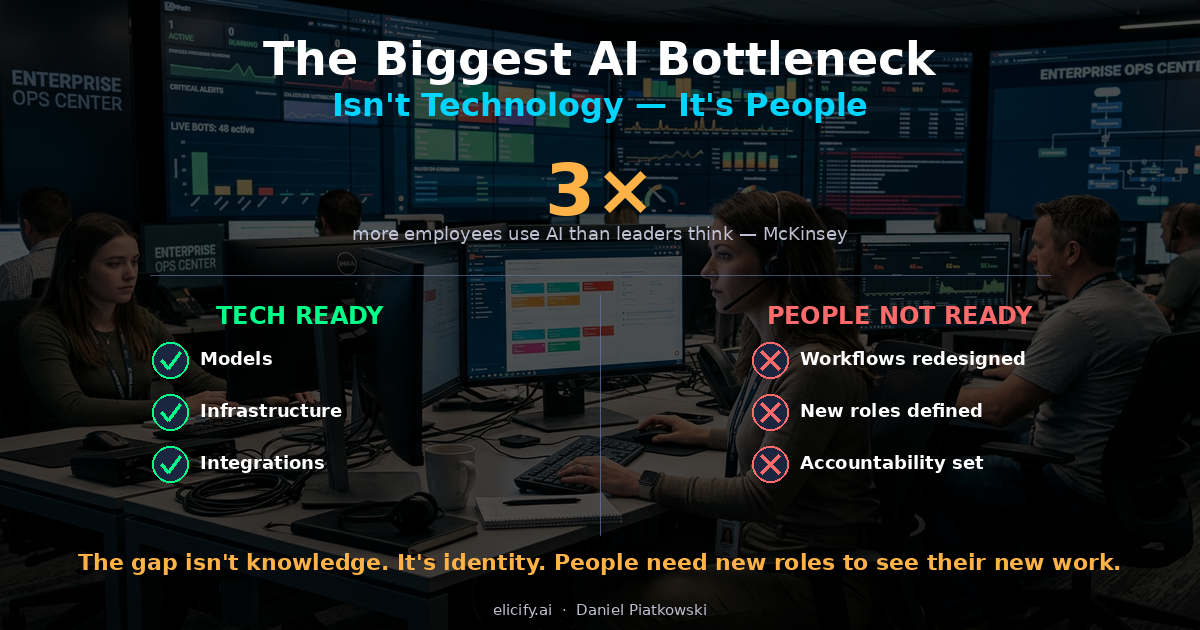
McKinsey's 2025 research found something that should alarm every enterprise leader: employees are three times more likely to be using generative AI than their leaders expect. Not 30% more likely. Three times. The tools have diffused through organisations faster than Slack or Zoom ever did. The operating model hasn't adapted at all.
That gap is where AI transformation stalls. And it has nothing to do with the technology.
The Wrong Diagnosis
Ask any enterprise technology leader what's slowing their AI transformation. You'll get three answers. The data isn't ready. The models aren't good enough. The integration is too complex.
These are real problems. They are not the biggest problem.
The data wasn't ready for cloud migration either, and organisations solved it. The models weren't good enough five years ago, and organisations worked around it. Integration has been complex since the first ERP system. These are solvable engineering challenges with known approaches, budgets, and timelines.
What doesn't have a known approach is the organisational redesign that must happen alongside the technology. Most enterprises are treating AI as a technology deployment with a change management wrapper. That's backwards. AI is an organisational change programme that happens to involve technology. The sequence matters. Technology without an operating model is capability without direction.
%%{init: {'theme': 'base', 'themeVariables': {'primaryColor': '#1a2540', 'primaryTextColor': '#ffffff', 'primaryBorderColor': '#ffffff', 'lineColor': '#ffffff', 'background': '#0a0f1e', 'mainBkg': '#1a2540', 'nodeBorder': '#ffffff', 'edgeLabelBackground': '#1a2540'}}}%%
graph LR
    subgraph WRONG ["What Most Enterprises Do"]
        W1["Buy the tool"] --> W2["Deploy the tool"] --> W3["Train on the tool"] --> W4["Wonder why adoption is 12%"]
    end
    subgraph RIGHT ["What Works"]
        R1["Redesign the workflow"] --> R2["Define new roles"] --> R3["Deploy tool into redesigned flow"] --> R4["Adoption hits 70%+"]
    end
    style WRONG fill:#2a1a1a,stroke:#ff6b6b,color:#ffffff
    style RIGHT fill:#0a2a1e,stroke:#00ff88,color:#ffffff
    style W1 fill:#1a2540,stroke:#ff6b6b,color:#ffffff
    style W2 fill:#1a2540,stroke:#ff6b6b,color:#ffffff
    style W3 fill:#1a2540,stroke:#ff6b6b,color:#ffffff
    style W4 fill:#1a2540,stroke:#ff6b6b,color:#ffffff
    style R1 fill:#1a2540,stroke:#00ff88,color:#ffffff
    style R2 fill:#1a2540,stroke:#00ff88,color:#ffffff
    style R3 fill:#1a2540,stroke:#00ff88,color:#ffffff
    style R4 fill:#1a2540,stroke:#00ff88,color:#ffffff
Three People Problems That Kill AI Initiatives
I've reviewed enough AI programmes now to see the same three failures repeat. They look different on the surface but share one root cause: the operating model was designed for human-only execution and has not been redesigned for human-AI collaboration.
The adoption gap. Tools get deployed. Usage stays low. The organisation blames the tool — "people don't like change," "the interface isn't intuitive," "we need better training." The real issue is usually that nobody redesigned the workflow around the tool. A claims adjuster given GPT-4 without a redesigned claims process will use it to draft emails slightly faster. That's not adoption. That's peripheral usage. Real adoption requires redesigning what the human does, what the AI does, and how they hand off between each other.
The skill mismatch. Working effectively with AI is not the same as learning to use a new software tool. It requires new cognitive skills: framing problems for probabilistic systems, evaluating outputs you didn't generate, maintaining oversight of a system that operates faster than you can monitor. These skills are not taught in standard corporate training. They're not taught in universities either, for the most part. The result is a workforce asked to collaborate with a partner whose strengths, weaknesses, and failure modes they do not understand.
The accountability vacuum. When a human makes a bad decision, the chain of accountability is clear. When an AI system contributes to a bad decision, it fragments. The data scientist built the model. The product manager specified the use case. The operations team deployed it. The compliance team reviewed it once. When the system produces a damaging outcome, each party has a partial explanation and nobody has ownership. This isn't a governance problem you solve with a committee. It's an operating model problem you solve by designing accountability into the human-AI division of labour from the start.
%%{init: {'theme': 'base', 'themeVariables': {'primaryColor': '#1a2540', 'primaryTextColor': '#ffffff', 'primaryBorderColor': '#ffffff', 'lineColor': '#ffffff', 'background': '#0a0f1e', 'mainBkg': '#1a2540', 'nodeBorder': '#ffffff', 'edgeLabelBackground': '#1a2540'}}}%%
graph TB
    Fail["Why AI Programmes Stall"]
    Fail --> G1["Adoption Gap
Tool without redesigned flow"]
    Fail --> G2["Skill Mismatch
Collaboration skills untaught"]
    Fail --> G3["Accountability Vacuum
Nobody owns outcomes"]
    G1 --> Root["Operating Model Designed for
Human-Only Execution"]
    G2 --> Root
    G3 --> Root
    style Fail fill:#1a2540,stroke:#ff6b6b,color:#ffffff
    style G1 fill:#1a2540,stroke:#ffb347,color:#ffffff
    style G2 fill:#1a2540,stroke:#ffb347,color:#ffffff
    style G3 fill:#1a2540,stroke:#ffb347,color:#ffffff
    style Root fill:#1a2540,stroke:#ff6b6b,color:#ffffff
The Reframe That Changes the Investment Thesis
The organisations that stall treat AI as a technology purchase. The organisations that accelerate treat it as an operating model redesign with technology as the enabler.
This changes every investment decision. Should we spend $2M on a better model or $2M on redesigning the workflows where that model will operate? Should we hire three more data scientists or three more process designers who understand human-AI collaboration? Should our AI steering committee report to the CTO or the COO?
I'm not sure there's a universal answer to these questions. The right answer depends on where your organisation is. What I am sure of is that organisations asking only the technology questions are solving the wrong problems. The technology is not the constraint. The constraint is organisational readiness to absorb what the technology makes possible.
What Redesign Actually Looks Like
A European pharmaceutical firm I worked with last year had deployed a GenAI tool for clinical trial documentation. Adoption after six months: 12%. The tool worked. The interface was fine. The training was comprehensive. The problem was that using the tool required clinicians to change a workflow that had evolved over fifteen years — who initiated the document, what sections they were responsible for, how approvals moved between medical, regulatory, and quality teams. Nobody had mapped that workflow before deploying the tool. The AI was faster at generating text, but it made the coordination between humans harder, not easier.
The fix wasn't better training. It was workflow redesign. Medical writers became document architects — they framed the structure, reviewed AI-generated sections, and managed exceptions. Regulatory reviewers shifted from line-by-line checking to sampling and risk-based review. Quality oversight moved upstream to monitor the AI's output patterns rather than reviewing individual documents. The operating model changed. Adoption hit 74% in three months.
The technology didn't change. The organisation did.
%%{init: {'theme': 'base', 'themeVariables': {'primaryColor': '#1a2540', 'primaryTextColor': '#ffffff', 'primaryBorderColor': '#ffffff', 'lineColor': '#ffffff', 'background': '#0a0f1e', 'mainBkg': '#1a2540', 'nodeBorder': '#ffffff', 'edgeLabelBackground': '#1a2540'}}}%%
graph LR
    Before["Medical Writer
(Writes every section)"] --> After["Document Architect
(Frames + reviews AI output)"]
    Before2["Regulatory Reviewer
(Line-by-line check)"] --> After2["Risk-Based Reviewer
(Sampling + patterns)"]
    Before3["Quality Oversight
(Per-document review)"] --> After3["Pattern Monitor
(Upstream AI output)"]
    style Before fill:#1a2540,stroke:#ff6b6b,color:#ffffff
    style Before2 fill:#1a2540,stroke:#ff6b6b,color:#ffffff
    style Before3 fill:#1a2540,stroke:#ff6b6b,color:#ffffff
    style After fill:#1a2540,stroke:#00ff88,color:#ffffff
    style After2 fill:#1a2540,stroke:#00ff88,color:#ffffff
    style After3 fill:#1a2540,stroke:#00ff88,color:#ffffff
The Technology Is Ready. The Question Is Whether the Organisation Is.
This is the uncomfortable truth that gets buried in vendor demos and technology roadmaps. The models are good enough. The infrastructure is mature enough. The integration patterns are well-understood. For most enterprise use cases, the technology is not the binding constraint.
The binding constraint is whether your organisation can redesign itself to work with AI rather than simply adding AI on top of how it already works. That requires process redesign, skill development, and accountability structures that most organisations have not started building.
The gap between what AI can do and what your organisation is prepared to do is your real competitive exposure. Not your model choice. Not your cloud provider. The organisational gap.
Close it before your competitors do.
Sources
- McKinsey: The State of AI in 2024
- Gartner: AI Adoption in the Enterprise
- MIT Sloan Management Review: Reskilling in the Age of AI
Daniel Piatkowski Data & Analytics veteran shaping AI-native enterprises elicify.ai