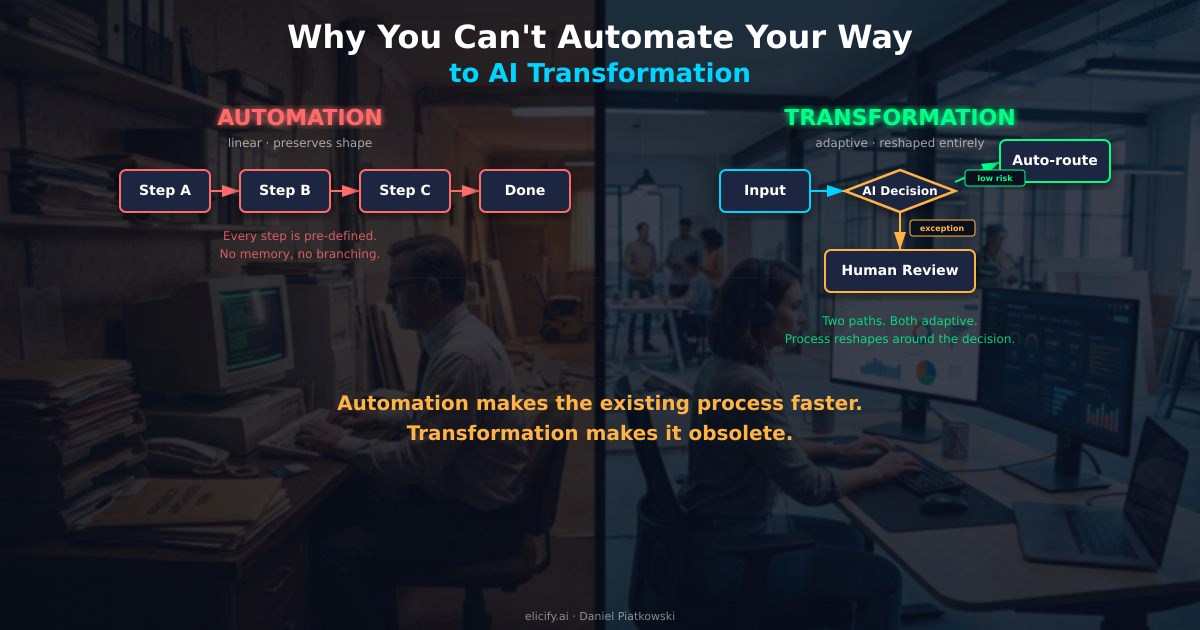
Automation and transformation are not the same thing. Confusing them is the most expensive mistake in enterprise AI right now.
McKinsey's 2025 State of AI research found that only 21% of organisations have fundamentally redesigned workflows to capture AI's value. The other 79% are buying automation and calling it transformation. The distinction is not semantic. It determines whether the investment compounds into competitive advantage or dissolves into operational noise within eighteen months.
The Wrong Question
Automation accepts the process as given — the steps, the sequence, the approval chains, the handoffs — and reduces the cost of executing it. It makes the existing process faster. It does not make it better.
Every structural feature of a legacy process exists because of constraints that no longer apply. Humans as the cognitive bottleneck. Siloed data. Synchronous decision-making. Manual error-catching. When you automate that process, you preserve the architecture while removing some of the human effort. The constraints shaped the process. The constraints are gone. The process remains.
Transformation asks a different question entirely: "If we were designing this process today, knowing what AI makes possible, what would it look like?" The answer requires identifying which steps are human-shaped — approval gates, review queues, handoffs that exist because humans couldn't access cross-functional data — versus which are genuinely necessary. Then redesigning from the outcome back, with AI at the centre and humans in governance and exception-handling roles.
Most organisations never ask this question. They ask "how do we make this process faster?" and end up with expensive automation that preserves the very constraints that limit their competitiveness.
The Three-Layer Gap
The gap between automation and transformation shows up across three layers. Organisations that automate at one layer and ignore the others end up with hybrid systems that are neither efficient nor transformed — a worst-of-both outcome that most enterprises don't see until year two of their programme.
%%{init: {'theme': 'base', 'themeVariables': {'primaryColor': '#1a2540', 'primaryTextColor': '#ffffff', 'primaryBorderColor': '#ffffff', 'lineColor': '#ffffff', 'background': '#0a0f1e', 'mainBkg': '#1a2540', 'nodeBorder': '#ffffff', 'edgeLabelBackground': '#1a2540'}}}%%
graph TB
    subgraph AUTO ["Automation"]
        A1["Architecture: AI on top of existing systems"]
        A2["Process: Human steps replaced with software"]
        A3["Operating Model: Same governance, new tools"]
    end
    subgraph TRANS ["Transformation"]
        T1["Architecture: Real-time, API-first, event-driven"]
        T2["Process: Redesigned for AI + human exception"]
        T3["Operating Model: New roles, new accountability"]
    end
    style AUTO fill:#2a1a1a,stroke:#ff6b6b,color:#ffffff
    style TRANS fill:#0a2a1e,stroke:#00ff88,color:#ffffff
    style A1 fill:#1a2540,stroke:#ff6b6b,color:#ff6b6b
    style A2 fill:#1a2540,stroke:#ff6b6b,color:#ff6b6b
    style A3 fill:#1a2540,stroke:#ff6b6b,color:#ff6b6b
    style T1 fill:#1a2540,stroke:#00ff88,color:#00ff88
    style T2 fill:#1a2540,stroke:#00ff88,color:#00ff88
    style T3 fill:#1a2540,stroke:#00ff88,color:#00ff88
Architecture. Automation puts AI on top of existing systems. The data still flows nightly. The APIs still return what they returned before. The AI layer reads, interprets, acts — within the constraints of architecture designed for human consumption. Transformation redesigns the system for AI. APIs become real-time. Events replace batch. Data that existed as reports now exists as streams that other systems, human or AI, can act on at decision speed.
Process. Automation replaces human steps with software steps. The sequence, approvals, and handoffs stay the same. Transformation redesigns the process from the outcome back. A transformed process doesn't have fewer steps — it has different steps, and different humans in different roles. The human isn't replaced. They're repositioned — from doing the work to governing the system that does the work.
Operating model. Automation requires the same governance structure, just with fewer people. Transformation requires a new governance structure designed for human-AI collaboration. Who owns AI decisions? How do humans and AI divide cognitive labour? Who is accountable when an AI system contributes to a wrong outcome? These questions don't have automation answers. They have transformation answers.
The Efficiency Trap
The most dangerous thing about automation is that it works. You get measurable efficiency gains. Costs go down. Throughput goes up. The ROI is positive and demonstrable. This creates a false sense of progress — the organisation feels like it's transforming because the metrics are moving.
Meanwhile, a competitor that chose transformation over automation is building a process architecture that gets better over time. Their AI doesn't just execute faster — it learns, adapts, and improves the process continuously. The automation advantage is a one-time step change. The transformation advantage compounds.
%%{init: {'theme': 'base', 'themeVariables': {'primaryColor': '#1a2540', 'primaryTextColor': '#ffffff', 'primaryBorderColor': '#ffffff', 'lineColor': '#ffffff', 'background': '#0a0f1e', 'mainBkg': '#1a2540', 'nodeBorder': '#ffffff', 'edgeLabelBackground': '#1a2540'}}}%%
graph LR
    Start["Year 0
Baseline"] --> Auto["Automation
+25% efficiency"]
    Start --> Trans["Transformation
-10% in year 1"]
    Auto --> A1["Year 1
+25%"]
    A1 --> A2["Year 2
+27%"]
    A2 --> A3["Year 3
+28%"]
    Trans --> T1["Year 1
-10%"]
    T1 --> T2["Year 2
+40%"]
    T2 --> T3["Year 3
+120%"]
    style Auto fill:#1a2540,stroke:#ff6b6b,color:#ff6b6b
    style A1 fill:#1a2540,stroke:#ff6b6b,color:#ffffff
    style A2 fill:#1a2540,stroke:#ff6b6b,color:#ffffff
    style A3 fill:#1a2540,stroke:#ff6b6b,color:#ffffff
    style Trans fill:#1a2540,stroke:#00ff88,color:#00ff88
    style T1 fill:#1a2540,stroke:#ffb347,color:#ffffff
    style T2 fill:#1a2540,stroke:#00ff88,color:#ffffff
    style T3 fill:#1a2540,stroke:#00ff88,color:#ffffff
I'm not sure most enterprises see this trade-off clearly. The automation path is safer, more predictable, and easier to justify to a board. The transformation path is uncertain, requires organisational change, and doesn't show results in the first quarter. But the organisations that take the transformation path are the ones that will be uncatchable in three years.
The Manufacturing Example
A European manufacturing firm I worked with last year had automated its quality control process around computer vision and anomaly detection. Agents flagged defects, scheduled rework, escalated exceptions. The old process preserved — inspection gates, review cycles, dispositioning — just executed by software. Throughput went up 30%. The CFO was delighted.
A competitor took the transformation path. They redesigned the quality process around what AI made possible: continuous in-line monitoring, upstream parameter adjustment, predictive defect prevention. The defect rate dropped 80%. More importantly, the process generated a dataset of defect patterns that improved the classification model continuously. Each defect made the next detection better. Each adjustment made the upstream process more capable.
Three years in, the first firm had automated away 30% of quality costs. The second firm had eliminated 80% of defects and built a compounding competitive advantage. The first firm cannot catch up by buying a better computer vision system. The competitor's advantage isn't the AI — it's the redesigned process architecture the AI sits inside.
Where Transformation Starts
Stop automating legacy processes. Start redesigning them from first principles. This requires a specific kind of question that most organisations don't ask.
Pick one high-value process. Map every step. For each step, ask: "Does this step exist because it's logically necessary, or because of a constraint that no longer applies in an AI-native world?" Eliminate the constraint-driven steps. Redesign the process around what AI makes possible. Build a feedback loop so the process improves over time.
Automation creates a one-time efficiency gain. Process redesign, combined with a feedback architecture, creates a compounding advantage — the process improves every time. That's the difference between paying catch-up and building a lead.
The organisations that understand this difference are the ones that will separate from the pack over the next three years. Not because their models are better. Because their architectures, processes, and operating models were designed for the world AI makes possible, not the world AI was bolted onto.
Sources
- McKinsey: The State of AI in 2024
- BCG: The CEO's Guide to AI Transformation
- Harvard Business Review: Sign Automating, Start Transforming
Daniel Piatkowski Data & Analytics veteran shaping AI-native enterprises elicify.ai