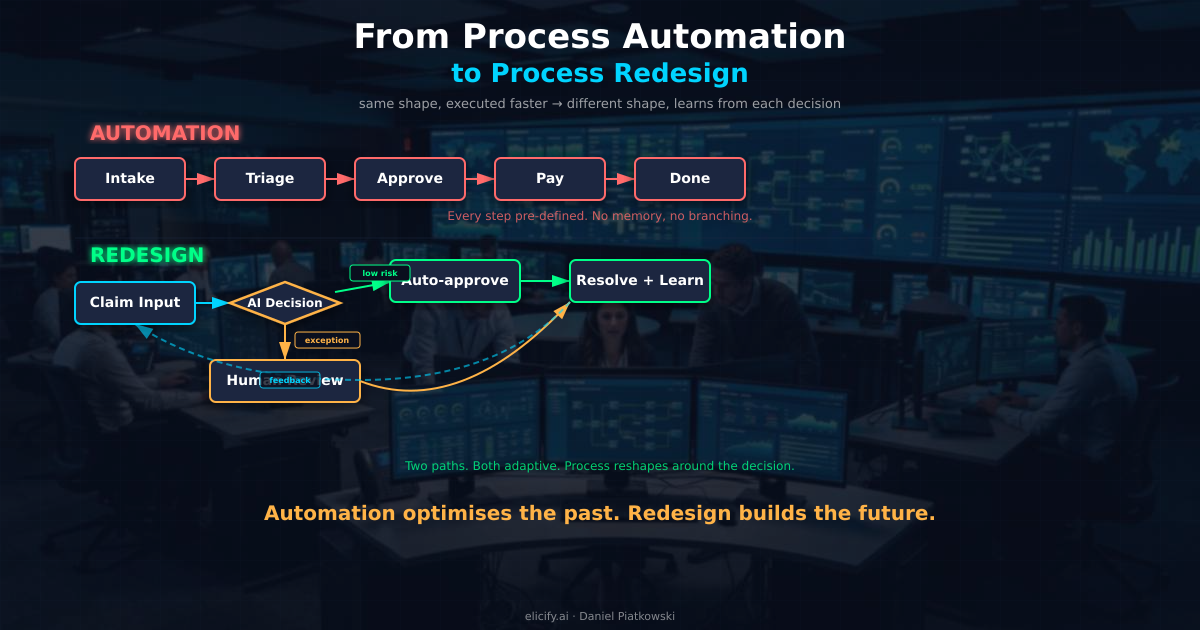
A decade of process automation has made enterprises operationally more efficient and strategically identical. Faster at doing what they already did. Not differentiated by how they do it.
That's the ceiling of automation — and most organisations are hitting it.
What Automation Actually Is
The fundamental assumption of automation is that the process shape is correct. It accepts the steps, the sequence, the handoffs, siloed data, synchronous decision-making, manual error-catching. When you automate that process, you preserve its architecture while removing some of the human effort. The constraints shaped the process. The constraints are gone. The process remains.
Every structural feature of a legacy process exists because of constraints that no longer apply. Humans as the cognitive bottleneck. Each step exists because a human shaped the step. Each approval gate exists because someone didn't trust the previous step. Each handoff exists because humans couldn't access cross-functional data simultaneously. A claims processing workflow has intake, triage, documentation review, approval, payment. Each step exists because a human needed it. You replace the human in each step with software. The process now runs faster. It's still the same process — automated, not redesigned.
Consider a typical claims processing workflow: intake, triage, documentation review, approval, payment. Each step exists because a human needed it. The process is faster. It still fundamentally a human-designed process, with human-shaped handoffs and human-paced approval chains. The AI doesn't redesign the process. It just executes it faster.
%%{init: {'theme': 'base', 'themeVariables': {'primaryColor': '#1a2540', 'primaryTextColor': '#ffffff', 'primaryBorderColor': '#ffffff', 'lineColor': '#ffffff', 'background': '#0a0f1e', 'mainBkg': '#1a2540', 'nodeBorder': '#ffffff', 'edgeLabelBackground': '#1a2540'}}}%%
graph LR
    subgraph AUTO ["Automation: Same Shape, Faster"]
        A1["Intake"] --> A2["Triage"] --> A3["Review"] --> A4["Approve"] --> A5["Pay"]
    end
    subgraph REDESIGN ["Redesign: Different Shape"]
        R1["Continuous intake"] --> R2{"AI decision"}
        R2 -->|"Low risk"| R3["Auto-pay"]
        R2 -->|"Exception"| R4["Human review"]
        R4 --> R5["Resolve + learn"]
        R5 -.-> R2
    end
    style AUTO fill:#2a1a1a,stroke:#ff6b6b,color:#ffffff
    style REDESIGN fill:#0a2a1e,stroke:#00ff88,color:#ffffff
    style A1 fill:#1a2540,stroke:#ff6b6b,color:#ffffff
    style A2 fill:#1a2540,stroke:#ff6b6b,color:#ffffff
    style A3 fill:#1a2540,stroke:#ff6b6b,color:#ffffff
    style A4 fill:#1a2540,stroke:#ff6b6b,color:#ffffff
    style A5 fill:#1a2540,stroke:#ff6b6b,color:#ffffff
    style R1 fill:#1a2540,stroke:#00ff88,color:#ffffff
    style R2 fill:#1a2540,stroke:#ffb347,color:#ffffff
    style R3 fill:#1a2540,stroke:#00ff88,color:#ffffff
    style R4 fill:#1a2540,stroke:#00ff88,color:#ffffff
    style R5 fill:#1a2540,stroke:#00ff88,color:#ffffff
The Redesign Question
Process redesign starts from a different point — not an optimised version of the old one. Agentic AI makes this shift urgent and possible simultaneously. Agents don't just execute steps; they coordinate across steps, make exception decisions, negotiate outcomes in real time and adapt. The process previously held in human judgment is now built into the system architecture.
The difference shows up in three specific ways:
From sequential to parallel. Legacy processes are sequential because humans can only do one thing at a time. AI-native processes are parallel because agents can coordinate multiple workstreams simultaneously. A claim can be validated, documented, and scored in a single action, not three sequential steps.
From exception-handling to exception-design. Legacy processes handle exceptions by escalating to humans. AI-native processes design for exceptions from the start: which exceptions can an agent resolve autonomously, which require human judgment, and how does the system learn from each exception to prevent similar ones? The exception becomes a data point, not a disruption.
From static to adaptive. Legacy processes are static because changing them requires human coordination. AI-native processes are adaptive because agents can adjust their behaviour based on real-time feedback. The process improves continuously without a human redesign cycle.
The Compounding Advantage
Automation creates a one-time efficiency gain. Redesign creates a structural advantage that gets harder to close the longer you wait.
When you automate a legacy process, your competitors can buy the same automation software and catch up. When you redesign a process around AI, the advantage compounds. Your process generates data that improves the AI. The AI improves the process. The gap between you and competitors who only automated widens over time.
%%{init: {'theme': 'base', 'themeVariables': {'primaryColor': '#1a2540', 'primaryTextColor': '#ffffff', 'primaryBorderColor': '#ffffff', 'lineColor': '#ffffff', 'background': '#0a0f1e', 'mainBkg': '#1a2540', 'nodeBorder': '#ffffff', 'edgeLabelBackground': '#1a2540'}}}%%
graph LR
    P["Redesigned Process"] --> D["Generates Decision Data"]
    D --> L["AI Learns Patterns"]
    L --> B["Better Decisions"]
    B --> P
    B --> E["Exceptions Decrease"]
    E --> C["Cost + Risk Decrease"]
    C --> A["Advantage Compounds"]
    style P fill:#1a2540,stroke:#00d4ff,color:#ffffff
    style D fill:#1a2540,stroke:#00d4ff,color:#ffffff
    style L fill:#1a2540,stroke:#ffb347,color:#ffffff
    style B fill:#1a2540,stroke:#00ff88,color:#ffffff
    style E fill:#1a2540,stroke:#00ff88,color:#ffffff
    style C fill:#1a2540,stroke:#00ff88,color:#ffffff
    style A fill:#1a2540,stroke:#00ff88,color:#ffffff
A manufacturing firm I worked with last year had redesigned its quality control process around computer vision and anomaly detection. The old process: inspect, flag, schedule rework, implement fixes. The new process: continuous monitoring, upstream parameter adjustment, defect prediction. Same industry. Similar data. Completely different process architecture. The defect rate dropped 80%. More importantly, the process generated a dataset of defect patterns that improved the classification model continuously. A competitor buying the same computer vision software cannot replicate this advantage without the process architecture.
The Urban Planning Analogy
This is the same mistake cities made with cars. You can't fix traffic by widening one road. You have to redesign the whole system — signals, zoning, public transit, parking. Every city that tried to solve car traffic by expanding roads ended up with more traffic. The constraint wasn't road width. It was the architecture of how movement worked.
Enterprise processes are the same. You can't fix the claims process by making intake faster. You have to redesign how work flows through the system. Every step that exists because of a human constraint is a candidate for elimination, not automation. The organisations that understand this don't ask "how do we automate this?" They ask "what would this process look like if we were designing it today, knowing what AI can do?"
Where Transformation Actually Starts
Pick one high-value process. Ask the redesign question: "If we were designing this process today, knowing what AI makes possible, what would it look like?" Build the feedback loop so the process improves continuously. That's where transformation actually starts.
Automation is a one-time gain. Redesign is a compounding advantage. The organisations that understand the difference are the ones that will separate from the pack over the next three years — not because they automated faster, but because they stopped automating and started redesigning.
The uncomfortable part of this shift is that redesigning takes longer than automating. It requires rethinking who does what, retraining people into new roles, and often admitting that the old process — the one the team has optimised for a decade — was built on assumptions that no longer hold. That's the hardest kind of change to sell. It's also the only kind that creates durable advantage.
Sources
- McKinsey: The State of AI in 2024
- Gartner: Process Mining and Automation
- Harvard Business Review: The Truth About Automation
Daniel Piatkowski Data & Analytics veteran shaping AI-native enterprises elicify.ai