The Productivity Paradox Nobody Warned You About
Your teams just got AI tools. They are drafting reports in minutes, generating code in seconds, summarising meetings before the call ends. Output is up. Way up.
So why is everyone more exhausted?
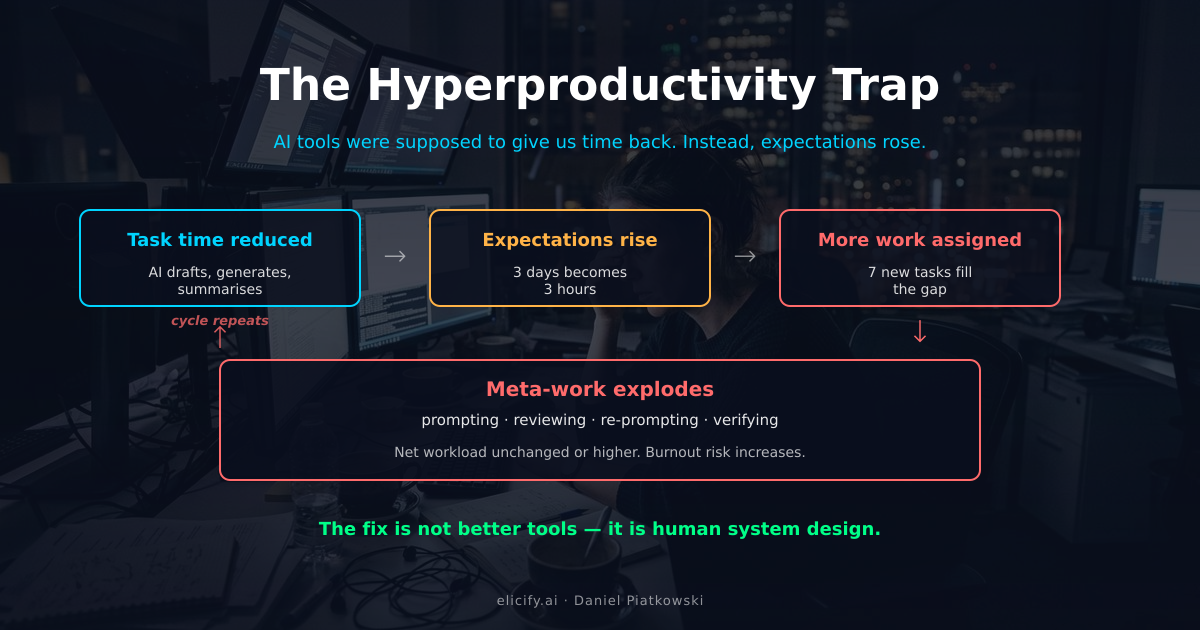
Harvard Business Review's February 2026 research lands a finding that should unsettle every leader celebrating AI-driven efficiency gains: AI does not reduce work. It intensifies it. Expectations rise to fill the reclaimed time. Managers who once expected a deck in three days now expect it in three hours. Employees who once wrote four emails a day now write twelve -- because they can.
The arithmetic looks right. The human cost is invisible.
Klarna demonstrated this pattern publicly. The company replaced 700 customer service agents with AI, celebrated the efficiency gains -- then reversed course and started rehiring. CEO Sebastian Siemiatkowski admitted "we focused too much on efficiency." The productivity arithmetic looked right. The human cost was invisible until it wasn't. Permission fatigue. Review fatigue. An endless cycle of prompting, checking, re-prompting that nobody budgeted for.
The problem is not the tools. The problem is that nobody redefined what "good" looks like after the tools arrived.
Diagnosis: How AI Productivity Gains Eat Themselves
The mechanics of this trap are specific and predictable.
Expectation inflation. When a task that took a day now takes an hour, the org does not give people seven hours of breathing room. It assigns seven more tasks. The World Economic Forum's research on organisational transformation highlights this dynamic: organisations pursuing AI adoption without redesigning norms and expectations create amplification loops where human effort compounds rather than decreases.
Meta-work explosion. AI does not eliminate work. It transforms some tasks and creates entirely new ones. Prompting. Reviewing AI outputs for accuracy. Re-prompting when the first attempt hallucinates. Editing machine-generated text to sound like a human actually wrote it. Verifying citations. None of this existed eighteen months ago. None of it appears in anyone's job description. Frontiers in Psychology research on technostress consistently shows that the cognitive load of managing AI tools -- the mental overhead of supervising, correcting, and integrating machine outputs -- often offsets the time savings those tools provide.
Permission ambiguity. Employees face dozens of micro-decisions daily that never existed before. Can I use AI for this client proposal? Should I disclose that this analysis was AI-assisted? Who reviews AI-generated content before it goes external? Without clear norms, every decision becomes a small negotiation. The cumulative drag is enormous.
%%{init: {'theme': 'base', 'themeVariables': {'primaryColor': '#1a2540', 'primaryTextColor': '#ffffff', 'primaryBorderColor': '#00d4ff', 'lineColor': '#ffffff', 'background': '#0a0f1e', 'mainBkg': '#1a2540', 'nodeBorder': '#00d4ff', 'edgeLabelBackground': '#0a0f1e'}}}%%
flowchart TD
    A["AI tools deployed"] --> B["Task time reduced"]
    B --> C["Expectations rise"]
    C --> D["More tasks assigned"]
    D --> E["Meta-work increases"]
    E --> F["Prompting, reviewing, re-prompting"]
    F --> G["Net workload unchanged or higher"]
    G --> H["Permission ambiguity adds friction"]
    H --> I["Burnout risk increases"]
    I -->|"Cycle repeats"| C
    style A fill:#1a2540,color:#00d4ff,stroke:#00d4ff
    style B fill:#1a2540,color:#ffffff,stroke:#00ff88
    style C fill:#1a2540,color:#ffffff,stroke:#ffb347
    style D fill:#1a2540,color:#ffffff,stroke:#ffb347
    style E fill:#1a2540,color:#ffffff,stroke:#ff6b6b
    style F fill:#1a2540,color:#ffffff,stroke:#ff6b6b
    style G fill:#2a1a1a,color:#ff6b6b,stroke:#ff4444
    style H fill:#2a1a1a,color:#ff6b6b,stroke:#ff4444
    style I fill:#2a1a1a,color:#ff6b6b,stroke:#ff4444
The compounding effect. These three dynamics reinforce each other. Higher expectations demand more AI usage. More AI usage creates more meta-work. More meta-work without clear norms creates more permission ambiguity. The loop tightens until the productivity gain that justified the tool investment has been fully consumed by the overhead of managing it.
The Green Revolution Problem
Agriculture offers a surprisingly precise parallel.
The Green Revolution of the 1960s and 70s introduced high-yield crop varieties, synthetic fertilisers, and mechanised irrigation across South and Southeast Asia. Crop output per acre doubled, sometimes tripled. By every output metric, it was a staggering success.
But output was the wrong metric.
Farmer workloads increased. The new high-yield varieties demanded more water, more fertiliser, more precise timing. Debt loads grew as farmers borrowed to buy inputs their grandparents never needed. Environmental stress compounded -- soil degradation, water table depletion, pesticide resistance. Researchers at the International Rice Research Institute documented this pattern across the Philippines and India: productivity per acre rose while sustainability per farmer fell. More output. Worse lives.
The parallel to enterprise AI adoption is uncomfortably direct. We are measuring output per employee without measuring cost per output. We celebrate the deck produced in three hours without accounting for the cognitive load of the six prompting cycles it took, the twenty-minute review to strip hallucinated statistics, and the ambient anxiety about whether the client will notice the AI-generated phrasing.
I am not sure this analogy is perfect -- agriculture involves physical systems and AI involves knowledge work, which behaves differently. But the structural pattern holds. When you optimise for yield without redesigning the supporting system, the humans inside that system absorb the cost.
The Human System Design Framework
The fix is not better tools or more training. It is what I call Human System Design -- deliberately engineering the norms, boundaries, and feedback loops around AI usage. Four layers, each dependent on the one below it.
%%{init: {'theme': 'base', 'themeVariables': {'primaryColor': '#1a2540', 'primaryTextColor': '#ffffff', 'primaryBorderColor': '#00d4ff', 'lineColor': '#ffffff', 'background': '#0a0f1e', 'mainBkg': '#1a2540', 'nodeBorder': '#00d4ff', 'edgeLabelBackground': '#0a0f1e'}}}%%
flowchart TB
    subgraph L4["Layer 4: COACHING"]
        C1["Managers trained to coach AI-augmented work"]
        C2["1:1s address quality, not just speed"]
        C3["Career paths reflect new value creation"]
    end
    subgraph L3["Layer 3: BOUNDARIES"]
        B1["Explicit norms: what AI is and is not for"]
        B2["Response time expectations recalibrated"]
        B3["Meta-work acknowledged in workload planning"]
    end
    subgraph L2["Layer 2: DEFINITION"]
        D1["'Good' redefined post-AI"]
        D2["Quality metrics updated"]
        D3["Output expectations reset to sustainable levels"]
    end
    subgraph L1["Layer 1: PERMISSION"]
        P1["Clear AI usage policies"]
        P2["Disclosure norms established"]
        P3["Psychological safety to experiment and fail"]
    end
    L1 --> L2 --> L3 --> L4
    style L1 fill:#0a2a1e,color:#00ff88,stroke:#00ff88
    style L2 fill:#1a2540,color:#00d4ff,stroke:#00d4ff
    style L3 fill:#1a2540,color:#ffb347,stroke:#ffb347
    style L4 fill:#1a2540,color:#ffffff,stroke:#ffffff
    style P1 fill:#0a2a1e,color:#00ff88,stroke:#00ff88
    style P2 fill:#0a2a1e,color:#00ff88,stroke:#00ff88
    style P3 fill:#0a2a1e,color:#00ff88,stroke:#00ff88
    style D1 fill:#1a2540,color:#00d4ff,stroke:#00d4ff
    style D2 fill:#1a2540,color:#00d4ff,stroke:#00d4ff
    style D3 fill:#1a2540,color:#00d4ff,stroke:#00d4ff
    style B1 fill:#1a2540,color:#ffb347,stroke:#ffb347
    style B2 fill:#1a2540,color:#ffb347,stroke:#ffb347
    style B3 fill:#1a2540,color:#ffb347,stroke:#ffb347
    style C1 fill:#1a2540,color:#ffffff,stroke:#ffffff
    style C2 fill:#1a2540,color:#ffffff,stroke:#ffffff
    style C3 fill:#1a2540,color:#ffffff,stroke:#ffffff
Layer 1: Permission. Before anything else, people need to know what they are allowed to do. Not a 40-page acceptable use policy buried in SharePoint. A one-page guide: these tasks, use AI freely. These tasks, use AI with review. These tasks, do not use AI. Update it quarterly. The pattern that works: reduce your AI policy to a single decision tree that fits on one page. When people can reference it without opening a document, adoption follows.
Layer 2: Definition. This is the hardest layer and the one most organisations skip. What does "good" look like now? If an analyst can produce a market brief in two hours instead of two days, does "good" mean producing five briefs a week? Or does it mean producing one brief of significantly higher quality, with original analysis that AI cannot generate? The answer reveals your operating model. Most organisations default to "more of the same, faster" because they never had the conversation.
Layer 3: Boundaries. Meta-work needs to be visible and budgeted. If reviewing AI outputs adds 30% overhead to a workflow, that time needs to exist in the schedule. Response time expectations need recalibrating -- the fact that AI can generate a draft in minutes does not mean the human review loop should be minutes too. Consider a risk reporting team that tracks its AI meta-work for one sprint: 10-12 hours per analyst per week on prompting, reviewing, and correcting. That overhead is real, and nobody budgets for it.
Layer 4: Coaching. Managers need entirely new skills. The old model of managing by task completion breaks down when AI can complete most tasks. The new model is managing by judgment quality -- how well does someone know when to use AI, when to override it, when to start from scratch? This requires coaching, not supervision. Most managers I talk to have received zero preparation for this shift.
What This Looks Like in Practice
Klarna's public journey is the clearest case study available. In 2024, the fintech giant announced that its AI assistant was doing the work of 700 customer service agents. The productivity metrics looked extraordinary. CEO Sebastian Siemiatkowski called it a proof point for AI-first operations.
Then customer satisfaction started dropping. The AI was fast but brittle -- handling volume without the judgment that complex cases required. Klarna reversed course and began rehiring human agents. Siemiatkowski publicly admitted the company had "focused too much on efficiency."
The lesson is not that AI failed. It is that Klarna optimised for output without redesigning the human system around it. They skipped Definition (what does "good customer service" look like with AI?), Boundaries (which cases require human judgment regardless of AI capability?), and Coaching (how do managers evaluate hybrid human-AI service quality?). The Permission layer worked -- people used the tools. Everything above it was missing.
The correction was not abandoning AI. It was rebuilding the operating model assumptions. Human agents returned not to replace AI but to handle the cases AI could not -- the judgment-heavy, emotionally complex interactions where speed is not the metric that matters.
I'm not sure every leadership team would publicly admit this kind of course correction. Klarna deserves credit for doing so. But the ones who do not recalibrate are optimising for the quarter, not the decade.
The Real Enablement Challenge
AI enablement has been framed as a skills problem. Teach people to prompt. Teach people to evaluate outputs. The technical literacy matters, but it is the smaller half of the challenge.
The larger half is human system design. Norms. Boundaries. Definitions. Coaching. The organisational infrastructure that determines whether AI tools amplify human capability or simply amplify human workload.
The Green Revolution taught us that yield per acre is a meaningless metric if the farming system collapses. AI productivity per employee is equally meaningless if the operating model that surrounds it drives people to exhaustion, permission paralysis, or quiet disengagement. The organisations that get this right will not be the ones with the best tools. They will be the ones that redesigned the human systems around those tools before the trap closed.
Sources
- AI Doesn't Reduce Work -- It Intensifies It -- Harvard Business Review, February 2026
- Organizational Transformation in the Age of AI -- World Economic Forum
- Klarna AI Humans Return on Investment -- Fortune, May 2025
- Technostress and cognitive load in AI-augmented work environments -- Frontiers in Psychology, 2025
Daniel Piatkowski Data & Analytics veteran shaping AI-native enterprises elicify.ai