The Agentic AI Reckoning
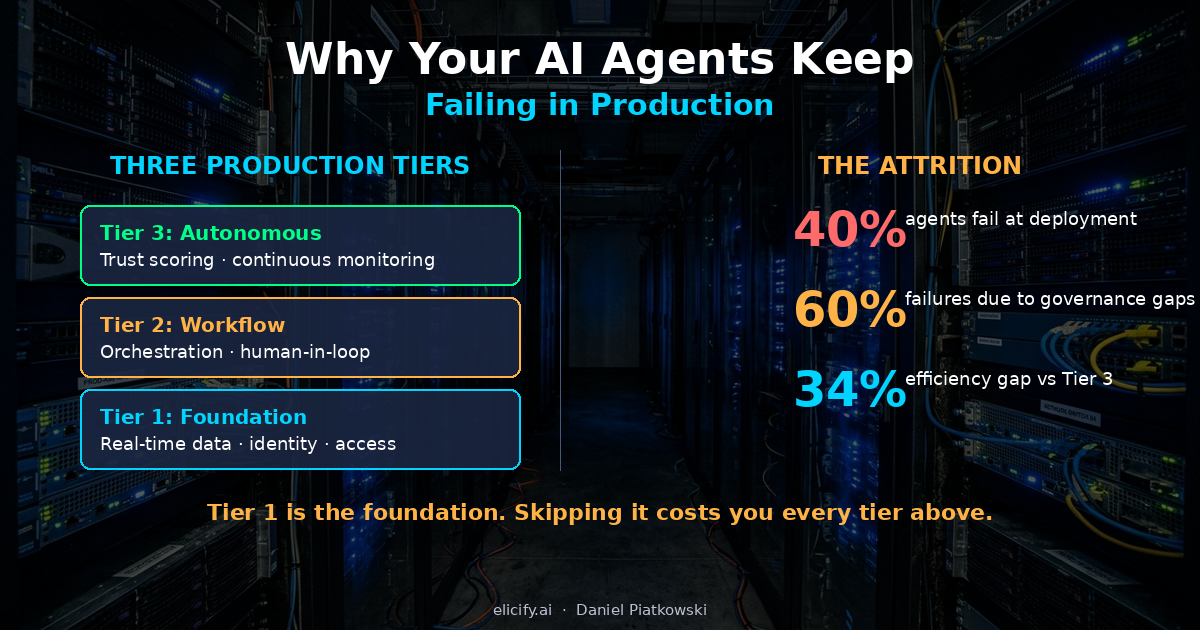
Gartner predicts that over 40% of agentic AI projects will be cancelled by end of 2027. Not because the models broke. Because the organisations deploying them skipped the foundations.
The agentic AI market is projected to grow from roughly USD 7.3 billion in 2025 to USD 52 billion by 2030, according to Information Matters. Every vendor has an agent story. Every consulting firm has an agent practice. The demos are dazzling. GPT-4o, Claude, Gemini -- they reason, plan, use tools, chain multi-step tasks.
Then the agent meets a real enterprise. Fragmented data pipelines. Decision rights nobody wrote down. Governance that exists as a slide deck, not a system. The pilot that impressed the steering committee collapses under production load, stale data, and zero observability. I have seen this pattern repeat across industries, and the root cause is almost never the model.
Diagnosis: Three Failure Modes That Have Nothing to Do With Models
The failures cluster. After studying enterprise agent deployments over the past year, I keep seeing the same three patterns. None of them are about model capability.
Agent sprawl. Sales gets a CRM agent. Support gets a ticket router. Finance gets a reconciliation bot. Each built independently, with its own tool access and logic. Within months, the CRM agent promises delivery timelines that logistics cannot support. The ticket router escalates cases the finance agent already resolved. Nobody has a unified view of what the agents are collectively doing. This is the microservices antipattern applied to AI: distributed complexity without orchestration.
The governance vacuum. Which decisions can the agent make autonomously? Who is accountable when it is wrong? What audit trail exists? Most enterprises answer these questions retroactively -- after the agent authorises a payment it should not have, or sends a customer communication that violates brand guidelines. Gartner separately projects that 60% of AI initiatives will miss their value targets by 2027 due to fragmented governance. Without pre-defined boundaries, every agent deployment is an uncontrolled experiment in production.
The architecture gap. This is the most fundamental failure and the hardest to fix after the fact. Agents need real-time data access, not yesterday's batch ETL. They need tool integration with guardrails, not open admin credentials. They need persistent state management across multi-step processes that span hours. And they need observability -- when something goes wrong, you need to trace the full decision chain. Most enterprise environments provide none of this.
%%{init: {'theme': 'base', 'themeVariables': {'primaryColor': '#1a2540', 'primaryTextColor': '#ffffff', 'primaryBorderColor': '#ffffff', 'lineColor': '#ffffff', 'background': '#0a0f1e', 'mainBkg': '#1a2540', 'nodeBorder': '#ffffff', 'edgeLabelBackground': '#1a2540'}}}%%
graph TD
    AGENT["AI Agent in Production"]
    AGENT --> D{"Real-time data?"}
    D -->|"No: batch/stale"| F1["Decisions on\noutdated information"]
    D -->|"Yes"| T{"Tool guardrails?"}
    T -->|"No: open access"| F2["Uncontrolled actions\nin production"]
    T -->|"Yes"| S{"State management?"}
    S -->|"No: stateless"| F3["Cannot handle\nmulti-step processes"]
    S -->|"Yes"| O{"Observability?"}
    O -->|"No: black box"| F4["Cannot debug\nor audit decisions"]
    O -->|"Yes"| OK["Production-Ready"]
    style F1 fill:#2a1a1a,stroke:#ff6b6b,color:#ff6b6b
    style F2 fill:#2a1a1a,stroke:#ff6b6b,color:#ff6b6b
    style F3 fill:#2a1a1a,stroke:#ff6b6b,color:#ff6b6b
    style F4 fill:#2a1a1a,stroke:#ff6b6b,color:#ff6b6b
    style OK fill:#0a2a1e,stroke:#00ff88,color:#00ff88,stroke-width:2px
    style AGENT fill:#1a2540,stroke:#ffffff,color:#00d4ff,stroke-width:2px
Reframe: Agents Are an Ecology Problem, Not an AI Problem
The instinct is to blame the agent. The model hallucinated. The prompt was wrong. The tools were unreliable. These are symptoms.
The real cause is that the agent was deployed into an environment that was never designed to support autonomous AI participants. The same agent, on the right foundation, succeeds -- not because the agent changes, but because the architecture provides what it needs.
Here is the unexpected connection that shifted my thinking on this. Ecologists studying species introduction have a concept called "habitat suitability." When a new species fails in an environment, biologists do not blame the organism. They assess whether the habitat provided the right conditions: food sources, absence of certain predators, compatible microbiome. The organism is fine. The habitat was wrong.
Enterprise AI agents are introduced species. They have capabilities -- reasoning, tool use, planning -- but those capabilities only express in the right habitat. Real-time data is the food source. Governance is the ecosystem boundary. Observability is the feedback loop that prevents runaway behaviour. Without those conditions, even a perfectly capable agent fails. Not because it is broken, but because its habitat cannot sustain it.
This is why Klarna's experience is so instructive. They replaced 700 customer service agents with AI, announced it was doing the equivalent work at a fraction of the cost, and then quietly started rehiring humans when customer satisfaction dropped. The AI was capable. The habitat -- workflows, escalation paths, quality feedback loops -- was not ready for full autonomy.
Framework: The Three-Tier Habitat for Agentic AI
Enterprise agentic AI requires a progression through three tiers. Skipping tiers is the primary cause of production failures.
%%{init: {'theme': 'base', 'themeVariables': {'primaryColor': '#1a2540', 'primaryTextColor': '#ffffff', 'primaryBorderColor': '#ffffff', 'lineColor': '#ffffff', 'background': '#0a0f1e', 'mainBkg': '#1a2540', 'nodeBorder': '#ffffff', 'edgeLabelBackground': '#1a2540'}}}%%
graph LR
    T1["Tier 1: Foundation\nData + Identity + Audit"]
    T2["Tier 2: Workflow\nOrchestration + HITL + Rollback"]
    T3["Tier 3: Autonomous\nTrust + Monitoring + Runtime Gov"]
    T1 -->|"Proven"| T2
    T2 -->|"Proven"| T3
    SKIP["Most enterprises\nskip to here"] -.-> T3
    SKIP -.->|"40% cancellation rate"| FAIL["FAIL"]
    style T1 fill:#1a2540,stroke:#ffffff,color:#00d4ff,stroke-width:2px
    style T2 fill:#1a2540,stroke:#ffffff,color:#ffb347,stroke-width:2px
    style T3 fill:#1a2540,stroke:#ffffff,color:#00ff88,stroke-width:2px
    style SKIP fill:#2a1a1a,stroke:#ff6b6b,color:#ff6b6b
    style FAIL fill:#2a1a1a,stroke:#ff6b6b,color:#ff6b6b
Tier 1: Foundation
Before deploying any agent, build the habitat.
Data layer. Real-time data access via streaming or change data capture. Governed, catalogued, lineage tracked. If your data is not trusted, your agents will not be trusted either. This means Databricks Unity Catalog or Snowflake governance -- not a shared file server.
Identity and access. Fine-grained permissions that apply to agents the same way they apply to humans. An agent gets a service identity with scoped access. Not a shared admin credential. I am still surprised how many enterprises skip this.
Audit infrastructure. Every agent action logged with full context -- not just what the agent did, but why. The data it saw, the reasoning chain, the alternatives it considered.
Tier 2: Workflow
With the foundation proven, deploy agents into structured workflows with explicit human checkpoints.
Orchestration. A central system that coordinates multiple agents, prevents conflicts, and enforces business rules. Without this, agent sprawl is inevitable. This is not optional.
Human-in-the-loop. The agent drafts, the human approves. The agent recommends, the human decides. These boundaries must be architectural -- enforced by the system, not by good intentions documented in a runbook nobody reads.
Rollback capability. If an agent takes a wrong action, you need the ability to undo it. Most agent frameworks do not provide this by default. That gap is harder to close than people expect.
Tier 3: Autonomous
Only after Tiers 1 and 2 are proven, selectively grant agents greater autonomy in low-risk, well-governed domains.
Trust scoring. A customer service response is lower risk than a financial transaction. Autonomous operation should be gated by domain risk and proven reliability history.
Continuous monitoring. Real-time anomaly detection. When an agent starts behaving differently from its established pattern, human review triggers automatically.
Runtime governance. Policy checks embedded in the execution path -- every decision validated against rules in real time, not reviewed quarterly.
%%{init: {'theme': 'base', 'themeVariables': {'primaryColor': '#1a2540', 'primaryTextColor': '#ffffff', 'primaryBorderColor': '#ffffff', 'lineColor': '#ffffff', 'background': '#0a0f1e', 'mainBkg': '#1a2540', 'nodeBorder': '#ffffff', 'edgeLabelBackground': '#1a2540'}}}%%
flowchart TD
    subgraph SPRAWL ["Without Orchestration"]
        S1["Sales Agent"] ---|"conflicting promises"| S2["Logistics Agent"]
        S2 ---|"duplicate work"| S3["Support Agent"]
        S3 ---|"contradictions"| S4["Finance Agent"]
        S1 ---|"no shared context"| S4
    end
    subgraph ORCHESTRATED ["With Shared Foundation"]
        O1["Orchestration Layer"]
        O1 --> O2["Sales Agent"]
        O1 --> O3["Logistics Agent"]
        O1 --> O4["Support Agent"]
        O1 --> O5["Finance Agent"]
        O6["Shared Data + Policy + Context"] --> O1
    end
    style SPRAWL fill:#2a1a1a,stroke:#ff6b6b,color:#ffffff
    style ORCHESTRATED fill:#0a2a1e,stroke:#00ff88,color:#ffffff
    style O1 fill:#1a2540,stroke:#ffffff,color:#00d4ff,stroke-width:2px
    style O6 fill:#1a2540,stroke:#ffffff,color:#00ff88,stroke-width:2px
Application: DHL and Maersk -- Building the Habitat First
DHL and Maersk both deployed AI for logistics routing -- high-volume, time-sensitive operations where manual decisions create bottlenecks. Both succeeded by building the habitat before deploying agents.
Tier 1: Foundation. Both companies invested in real-time data layers first. DHL connected inventory systems, carrier APIs, and customer order data across their global network. Maersk built AI-driven routing across their shipping operations, integrating weather data, port congestion signals, and fuel consumption models into a unified decision layer. This was unglamorous work. No demo. No executive showcase. Just plumbing.
Tier 2: Supervised workflow. AI routing recommendations were deployed alongside human dispatchers. The system recommended routes; humans reviewed and approved. Every recommendation was logged with data inputs and reasoning. The approval rate over time became the evidence that justified increasing autonomy.
Tier 3: Selective autonomy. Routine shipments -- standard routes, normal conditions, under complexity thresholds -- now route autonomously. Complex shipments stay in the human-in-the-loop workflow. Continuous monitoring flags any recommendation that deviates from established patterns.
The results are public. DHL cut transportation costs by 15% and reduced delivery times by 30% through AI route optimisation. Maersk saved 15% on fuel costs and reduced shipping times by 20%. The agents succeeded not because they were better models. They succeeded because the habitat was right.
Implication: Architecture Before Agents
The 40% cancellation rate is not a verdict on agentic AI. It is a verdict on how enterprises deploy it. McKinsey's 2025 State of AI survey found that no more than 10% of respondents are scaling AI agents in any business function. The gap between experimentation and production remains vast.
The question is not "which agent framework should we use?" It is "does our architecture provide the habitat these agents need to survive?" If the honest answer is no, building agents is premature. Build the habitat first.
Sources
- Gartner: Over 40% of agentic AI projects will be cancelled by 2027
- Information Matters: Global Agentic AI Market Forecasts 2025-2030
- Gartner: 60% of AI initiatives will miss value targets by 2027 due to governance gaps
- Fortune: Klarna reverses AI-first customer service strategy
- McKinsey: The State of AI in 2025 -- Agents, Innovation, and Transformation
- DHL: AI in Logistics
- Maersk: Artificial Intelligence in Logistics
Daniel Piatkowski Data & Analytics veteran shaping AI-native enterprises elicify.ai