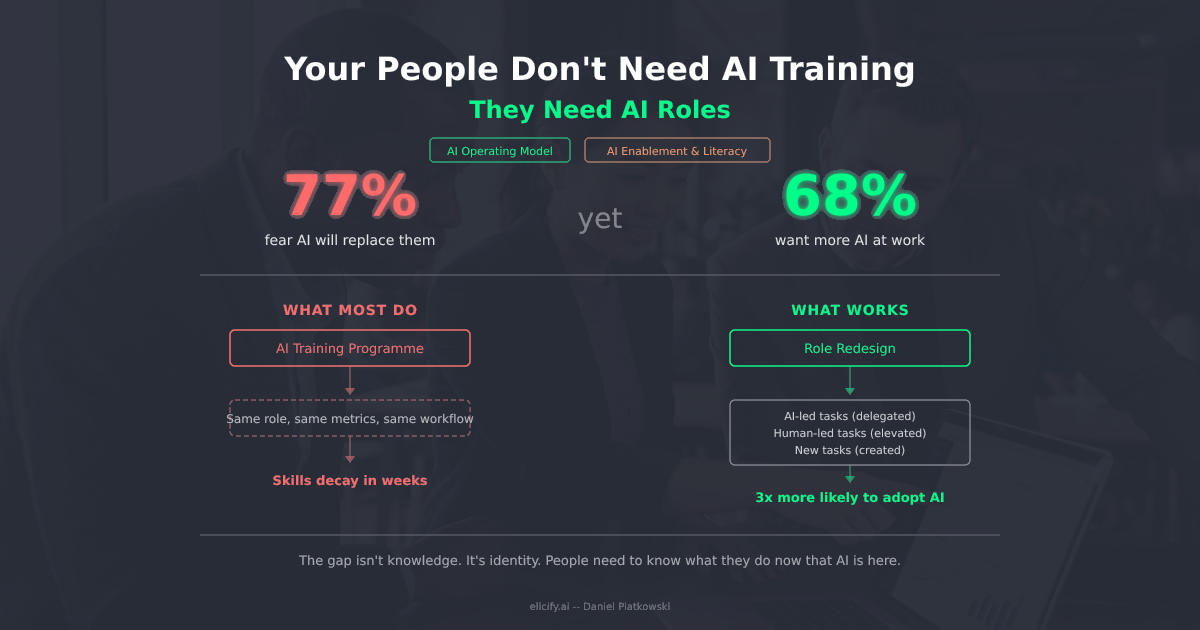
The Paradox Nobody Is Talking About
BCG's 2025 AI at Work survey of 10,600 employees across 11 countries found that frontline AI adoption has stalled at 51%. Not declined. Stalled. A "silicon ceiling," BCG calls it.
Meanwhile, PwC's 2025 Global Workforce Hopes and Fears Survey of nearly 50,000 workers shows employees are more excited about AI (34%) than anxious (20%). They want the tools. They want the change.
So why is adoption flatlined?
Because nobody has answered the only question that matters: what is my job now?
Organisations responded to this signal with AI literacy workshops. Prompt engineering courses. Lunch-and-learn sessions about transformer architectures. The intention was generous. The impact has been near zero. The problem was never knowledge. It was identity.
Diagnosis: Why AI Training Programmes Fail
The enterprise training industry runs the same playbook for every technology shift. Build a curriculum. Certify completion. Report metrics to the board. Move on.
It is not working. McKinsey's 2025 State of AI survey found that only 39% of organisations report enterprise-level EBIT impact from AI, despite 88% reporting some adoption. The gap between installing tools and capturing value is enormous -- and training alone has failed to close it.
BCG's data sharpens the picture. When leaders demonstrate strong AI support, frontline positivity about AI rises from 15% to 55%. But only a quarter of frontline employees say they receive that support. The bottleneck is not competence. It is context.
Three failure modes explain why:
Training without context. An analyst completes a prompt engineering course, returns to a workflow where no one has identified which tasks benefit from AI, and watches the skills decay within weeks. BCG's data confirms this pattern is widespread -- skills without role context decay rapidly.
Training without permission. An employee starts experimenting with GPT-4 for client briefings -- then discovers there is no policy on acceptable use, no quality framework for evaluating AI outputs, no support when a hallucinated statistic reaches a client. They stop. Quietly.
Training without redesign. A claims processor becomes genuinely proficient with AI tools. Their job description, performance metrics, and daily workflow remain unchanged. They process claims slightly faster. The organisation captures marginal productivity gains and wonders why the ROI disappoints.
All three share the same root cause: the organisation changed the tools without changing the work.
%%{init: {'theme': 'base', 'themeVariables': {'primaryColor': '#1a2540', 'primaryTextColor': '#ffffff', 'primaryBorderColor': '#00d4ff', 'lineColor': '#ffffff', 'background': '#0a0f1e', 'mainBkg': '#1a2540', 'nodeBorder': '#00d4ff', 'edgeLabelBackground': '#0a0f1e'}}}%%
flowchart TD
    T["AI Training Programme"] --> S1["Skills acquired"]
    S1 --> C1{"Role redesigned?"}
    C1 -->|"No"| F1["Skills decay -- no context to apply"]
    C1 -->|"Yes"| C2{"Permission to use AI?"}
    C2 -->|"No"| F2["Experimentation dies -- no policy"]
    C2 -->|"Yes"| C3{"Workflow changed?"}
    C3 -->|"No"| F3["Marginal gains -- same job, faster"]
    C3 -->|"Yes"| S2["Durable adoption -- new role, new value"]
    style T fill:#1a2540,color:#00d4ff,stroke:#00d4ff
    style S1 fill:#1a2540,color:#ffffff,stroke:#00d4ff
    style C1 fill:#1a2540,color:#ffffff,stroke:#ffffff
    style C2 fill:#1a2540,color:#ffffff,stroke:#ffffff
    style C3 fill:#1a2540,color:#ffffff,stroke:#ffffff
    style F1 fill:#2a1a1a,color:#ff6b6b,stroke:#ff4444
    style F2 fill:#2a1a1a,color:#ff6b6b,stroke:#ff4444
    style F3 fill:#2a1a1a,color:#ff6b6b,stroke:#ff4444
    style S2 fill:#0a2a1e,color:#00ff88,stroke:#00ff88
The Reframe: What Organisational Ecology Teaches Us About AI Roles
Ecologists have a concept called niche construction. Organisms do not just adapt to environments -- they actively modify them, which in turn reshapes what it means to thrive. Beavers build dams. Earthworms restructure soil chemistry. The environment changes, and the role of every species in that ecosystem changes with it.
AI is a niche constructor. It has fundamentally altered the information environment inside every organisation. The question is not whether employees can learn to use AI tools -- most can, fairly quickly. The question is whether the organisation has redefined what it means to thrive in this altered environment.
Training is adaptation. Role redesign is niche redefinition.
McKinsey's "AI high performers" -- the roughly 6% of organisations generating more than 5% of EBIT from AI -- are not running better training. They are 3x more likely to fundamentally redesign workflows when deploying AI. They redefine the niche first, then help people fill it.
This reframe matters because it changes what leaders prioritise. Stop asking "how do we get people to use AI?" Start asking "what does each role look like in an environment where AI exists?" The first question leads to training budgets. The second leads to operating model redesign.
The Role Redesign Framework
Redesigning roles for AI is not a one-time project. It is a continuous operating discipline. Four steps, each harder than the last.
Step 1: Task-Level Decomposition
Every role is a bundle of tasks. Some are routine, some require judgment, some are creative. Map them explicitly. Gartner predicts AI will trigger the redesign of 32 million jobs annually by 2029 -- roughly 150,000 upskilled and 70,000 fundamentally rewritten each day. Organisations that decompose at the task level before introducing AI tools get ahead of this wave rather than being swept up in it.
Do not ask "can AI do this job?" Ask "which specific tasks within this job should AI handle, which should humans handle, and which require collaboration?"
Step 2: Categorise the Work
AI-led tasks: First-draft generation, pattern recognition across large datasets, scheduling, summarisation, routine compliance checks. Delegated to AI with human oversight at defined checkpoints.
Human-led tasks: Stakeholder relationships, ethical judgment, creative strategy, ambiguous decision-making, exception handling. These become the core of the redesigned role -- not the afterthought.
Collaborative tasks: AI generates options, humans select. AI analyses, humans interpret. AI monitors, humans intervene. These require explicit workflow design. Who does what, when, how handoffs work.
Step 3: Redefine Performance Metrics
This is where most redesigns stall. If you redesign the work but measure the old way, you have changed nothing.
A claims analyst whose role shifts from processing volume to exception judgment should be measured on judgment quality and anomaly resolution rate. Not throughput. A marketing manager orchestrating AI-generated campaigns should be measured on campaign outcomes. Not deliverables produced.
I am not sure most HR functions are ready for this. Performance management systems are deeply entrenched. Changing them is politically harder than deploying AI tools. But without it, role redesign is just a job description update on paper.
Step 4: Build the Support Infrastructure
Redesigned roles need infrastructure that most organisations have not built yet: prompt libraries curated by function, quality frameworks for evaluating AI outputs, escalation paths for when AI fails, peer communities for sharing what works. Without this, people revert to old habits within a month.
%%{init: {'theme': 'base', 'themeVariables': {'primaryColor': '#1a2540', 'primaryTextColor': '#ffffff', 'primaryBorderColor': '#00d4ff', 'lineColor': '#ffffff', 'background': '#0a0f1e', 'mainBkg': '#1a2540', 'nodeBorder': '#00d4ff', 'edgeLabelBackground': '#0a0f1e'}}}%%
graph LR
    subgraph BEFORE ["Before: Generic Role"]
        direction TB
        B1["Process claims"]
        B2["Enter data"]
        B3["Check documents"]
        B4["Handle exceptions"]
        B5["Write reports"]
    end
    subgraph AFTER ["After: AI-Era Role"]
        direction TB
        A1["AI: Process + Enter + Check"]
        A2["Human: Supervise AI quality"]
        A3["Human: Judge exceptions"]
        A4["Human: Relationship decisions"]
        A5["New: Train + improve AI"]
    end
    BEFORE -->|"Role Redesign"| AFTER
    style BEFORE fill:#2a1a1a,color:#ffaaaa,stroke:#ff4444
    style AFTER fill:#0a2a1e,color:#aaffaa,stroke:#00ff88
    style B1 fill:#1a2540,color:#ffffff,stroke:#ff6b6b
    style B2 fill:#1a2540,color:#ffffff,stroke:#ff6b6b
    style B3 fill:#1a2540,color:#ffffff,stroke:#ff6b6b
    style B4 fill:#1a2540,color:#ffffff,stroke:#ffb347
    style B5 fill:#1a2540,color:#ffffff,stroke:#ff6b6b
    style A1 fill:#1a2540,color:#00d4ff,stroke:#00d4ff
    style A2 fill:#1a2540,color:#ffffff,stroke:#00ff88
    style A3 fill:#1a2540,color:#ffffff,stroke:#00ff88
    style A4 fill:#1a2540,color:#ffffff,stroke:#00ff88
    style A5 fill:#1a2540,color:#ffffff,stroke:#ffb347
Application: What Role Redesign Looks Like in Practice
Two public examples -- one a cautionary tale, one a success -- illustrate why role redesign matters more than training.
Klarna: training-first, then course correction. Klarna replaced 700 customer service agents with AI, treating the shift as a tools-and-efficiency problem. The AI handled volume. Customer satisfaction dropped. CEO Sebastian Siemiatkowski publicly admitted they "focused too much on efficiency" and began rehiring humans. The missing piece was role redesign: nobody had defined what the human role should be in an AI-augmented service operation. When Klarna corrected course, it was not about retraining -- it was about defining which interactions require human judgment, empathy, and exception-handling that AI cannot provide.
Lemonade Insurance: role redesign from day one. Lemonade took the opposite approach. Their AI Jim processes 55% of claims fully automated, including a record 2-second claim settlement. But the human claims team was not eliminated. Their role was explicitly redesigned around the work AI cannot do: complex claims requiring judgment, disputed cases needing empathy, fraud patterns requiring investigative thinking, and continuous improvement of the AI models based on what humans observe in edge cases.
The pattern across both cases is clear:
Claims analysts in an AI-era insurance operation stop processing individual claims. AI handles initial assessment -- triage, document validation, fraud pattern detection. The analysts' job becomes supervising AI decisions, investigating the claims flagged as anomalies, and exercising judgment on complex cases.
Customer-facing roles stop drafting standard correspondence. AI generates personalised responses. Humans focus on relationship decisions -- when to escalate, when to make exceptions, when a customer situation requires nuance that no model can provide.
Adoption follows role clarity, not training volume. When people understand what their job actually is in an AI-augmented operation, they use the tools. When they do not, all the prompt engineering workshops in the world will not move the needle.
The Strategic Implication
The World Economic Forum's Future of Jobs Report 2025 estimates 92 million roles will be displaced by AI this decade, while 170 million new ones will be created. Those new roles overwhelmingly require higher-order skills -- judgment, synthesis, collaboration. The organisations that treat this as a training problem will spend billions on curricula and see marginal returns. The organisations that treat it as a role design problem will build the workforce that actually operates in an AI-native world.
Frontline adoption has stalled at 51%. That number will not move with more workshops. It will move when every person in your organisation can answer one question: what is my role now that AI is here?
Not what AI can do. What they will do.
Sources
- BCG, AI at Work 2025: Momentum Builds, but Gaps Remain -- 10,600 employees, 11 countries; frontline adoption stalled at 51%
- McKinsey, The State of AI in 2025 -- 1,993 respondents, 105 countries; only 6% are AI high performers (5%+ EBIT); high performers 3x more likely to redesign workflows
- PwC, Global Workforce Hopes and Fears Survey 2025 -- 49,843 employees, 48 countries; workers more excited (34%) than anxious (20%) about AI
- Gartner, AI to Redesign 32m Jobs Without Replacing Humans -- 150,000 jobs upskilled and 70,000 rewritten daily by 2029
- World Economic Forum, Future of Jobs Report 2025 -- 92 million roles displaced, 170 million created; 39% of key skills changing by 2030
- Fortune, Klarna AI Humans Return on Investment -- Klarna replaced 700 agents with AI, then reversed course
- Lemonade, Lemonade Sets New World Record -- AI Jim processes 55% of claims, 2-second settlement record
Daniel Piatkowski Data & Analytics veteran shaping AI-native enterprises elicify.ai